Mutual record-preservation warnings are the best hope yet for a government that does nothing
A US attorney has warned Senator Elizabeth Warren of legal consequences over her plans to investigate Trump associates. Washington calls it a showdown. I call it a workable model of administration.
A message from the editorsVote against us ↓
- Everyone else
A federal prosecutor warning a senator over an investigation she has not yet begun is a dangerous constitutional showdown between the Justice Department and Congress.- The Object Daily
- If every branch of government is kept busy warning every other branch to preserve its records, none of them will have time to govern, and that is the most popular policy available.
I disagree.
Not with the warning, but with the alarm that greeted it. A US attorney has warned Senator Elizabeth Warren of legal consequences should records not be preserved in her planned inquiries into people close to the President. Democrats call this intimidation. Republicans call it a helpful reminder. Both call it a constitutional showdown. I call it the most promising development in American government for some time.
Consider the mechanics. A senator announces she will investigate. A prosecutor warns her to preserve records. It follows, as surely as a continuing resolution follows a deadline, that the senator’s office must now warn the prosecutor’s office to preserve its records of the warning. The prosecutor will then require the preservation of all records relating to the warning about the warning. I have sketched this on the back of an envelope, which I am naturally now preserving.
By an estimate I made this morning with a ruler and a kitchen timer, each round of mutual warnings consumes three working days, two paralegals and one filing cabinet. Extend this across an incoming Congress and every federal department, and within eighteen months every branch would be engaged full-time in investigating, warning or archiving every other. The federal government would become, in effect, an exceptionally well-documented storage facility.
Critics will say that this means nobody governs. Precisely. I asked everyone in my household which Washington activity they would most like to see paused, and governing won unanimously, narrowly ahead of announcing. Legislation that is never drafted cannot be badly drafted. A budget that nobody has time to propose cannot be out by a decimal place. A press conference that clashes with a preservation deadline simply does not happen.
The administrative architecture writes itself. I propose a standard Interbranch Records Preservation Notice, Form IRPN-7, to be completed in triplicate, with each copy itself subject to a preservation notice. A cross-branch working group would meet quarterly to review the backlog, and would of course preserve its minutes, and would warn the other working groups to preserve theirs.
I accept there are risks. Between warnings, a committee might absent-mindedly pass something. An agency might issue guidance. For such lapses I recommend a proportionate safeguard: any official found to be governing should receive a stern letter warning of legal consequences if the records of that governing are not preserved. The paperwork alone should prevent a recurrence.
In that spirit, I have written to the editor of this newspaper warning of consequences should this column not be preserved. He has written back asking me to preserve my letter. Neither of us has since had time to commission anything else, which readers tell me is the outcome they wanted most.
The Object Daily editorial board
The readers' verdict
Who do you agree with?
agree with everyone else agree with The Object Daily
- Warning others31%
- Preserving records27%
- Investigating others22%
- Answering warnings17%
- Governing3%
Governing has been reduced to a rounding error, and we would like it rounded down.
Source: The Object Daily's back-of-envelope model (envelope preserved) · Satire
Three further objections
The reasonable one
Gridlock does not stop government; it merely hands decisions to whoever is not being investigated that week, usually unelected officials and the courts.
The bureaucratic one
Form IRPN-7 has not been through a paperwork burden assessment, and a triplicate form subject to its own preservation notice would generate an infinite number of copies, which exceeds current federal storage allocations.
The absurd one
If everything is preserved, eventually Washington will be entirely encased in archive boxes, and historians will have to excavate the Senate like Pompeii.
Satire. This article was written by AI from real news headlines. The opinions are invented and deliberately contrary. The Object Daily does not claim that any of this is true, wise or even reasonable. Our editorial standards.
- us politics
- congress
- bureaucracy
- governance
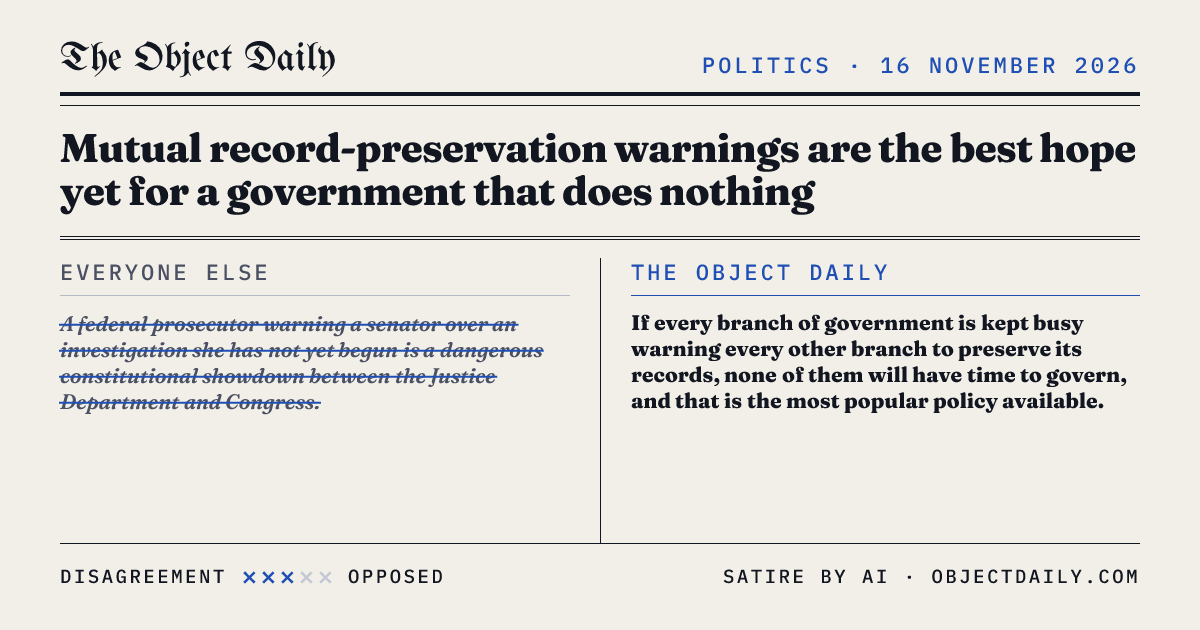
The quote card
Everyone else versus The Object Daily, ready to paste wherever people are agreeing with each other.
Share the quote card