Criminalise congressional oversight, and backdate it to 1789 so nobody feels left out
The White House has warned the incoming Democratic Congress that investigating it may be a crime. Washington is appalled. I am appalled only that it has taken 237 years to put it in writing.
A message from the editorsVote against us ↓
- Everyone else
The warning is an extraordinary attack on Congress's constitutional duty to scrutinise the executive.- The Object Daily
- Criminalising oversight would merely codify what both parties have alleged about each other's hearings for two centuries, and fairness demands that it apply retroactively to every one of them.
I disagree.
Not with the White House, whose warning that investigating the administration may be criminal has been met across Washington with the kind of horror normally reserved for a Friday-afternoon quorum call. I disagree with the horror. For the first time in living memory, an executive has proposed to write down a rule that Congress has observed informally, but with great dedication, since roughly the second week of the First Congress.
Consider the established practice. Whichever party holds the gavel investigates the other. Whichever party does not describes the investigation as a witch-hunt, an outrage, a weaponisation and, at least once per session, a crime against the republic. Both parties have therefore long believed that oversight is criminal. They have simply never agreed on whose. A law that everyone already believes in but nobody has bothered to draft is not a constitutional principle. It is a clerical backlog.
My only objection to the White House is its timidity. If oversight is a crime, it cannot sensibly become one in January. That would be favouritism towards the present. Justice requires that the offence apply retroactively to every committee hearing, sub-committee session and so-called roundtable since 1789. According to an estimate I made this morning, between the toast and the marmalade, this would generate roughly 393,000 counts, a figure I have rounded down out of courtesy to the Senate.
The machinery would need some thought. Every witness who testified would be an accessory. Every member who said I yield back the balance of my time would be charged with conspiracy, the yielding being plainly an overt act. The Department of Justice, which has itself been the subject of several thousand hearings, would be required to prosecute the very proceedings in which it was a victim, and would need to recuse itself from approximately all of them.
The benefits, however, are considerable. At present a hearing is a five-minute monologue followed by a fundraising email. Moved to a courtroom, it would acquire rules of evidence, a requirement that questions be relevant and a judge empowered to say sustained, all of which Congress has historically regarded as optional extras. Criminalising oversight may be the only way left to make it rigorous.
I note that the incoming chair of the House Oversight Committee has pointed out that the Constitution gives Congress latitude to conduct investigations. Latitude, I would gently observe, is a geographical term. The Capitol sits at about 38.89 degrees north. Congress has latitude in abundance. What it has never had is a statute.
There remains one small difficulty, which I raise in the spirit of constructive consultation. To pass such a law, Congress would first have to hold hearings on it, and those hearings would themselves be retroactively criminal. I therefore propose that the bill be enacted without any scrutiny whatsoever. I am assured by several former staffers that this, too, is established practice.
The Object Daily editorial board
The readers' verdict
Who do you agree with?
agree with everyone else agree with The Object Daily
- 1789–1799412 counts
- 1800–189938,600 counts
- 1900–194571,200 counts
- 1946–1999164,900 counts
- 2000–2026117,900 counts
The post-war surge in hearings shows Congress has been committing the offence at an industrial scale, and courtesy alone keeps the total at 393,012.
Source: The Object Daily Retrospective Docket, compiled between the toast and the marmalade · Satire
Three further objections
The reasonable one
If oversight is criminal, the only body left to check the executive is the executive, which is the arrangement the Constitution was written specifically to avoid.
The bureaucratic one
Retroactive prosecution of 237 years of hearings would require a records-retention schedule the National Archives has not yet approved, and form ROH-1789 is only available in quill.
The absurd one
Latitude cannot be the basis of anything, as the Capitol moves several centimetres a year on its tectonic plate and therefore enjoys no fixed jurisdiction.
Satire. This article was written by AI from real news headlines. The opinions are invented and deliberately contrary. The Object Daily does not claim that any of this is true, wise or even reasonable. Our editorial standards.
- us politics
- white house
- congress
- governance
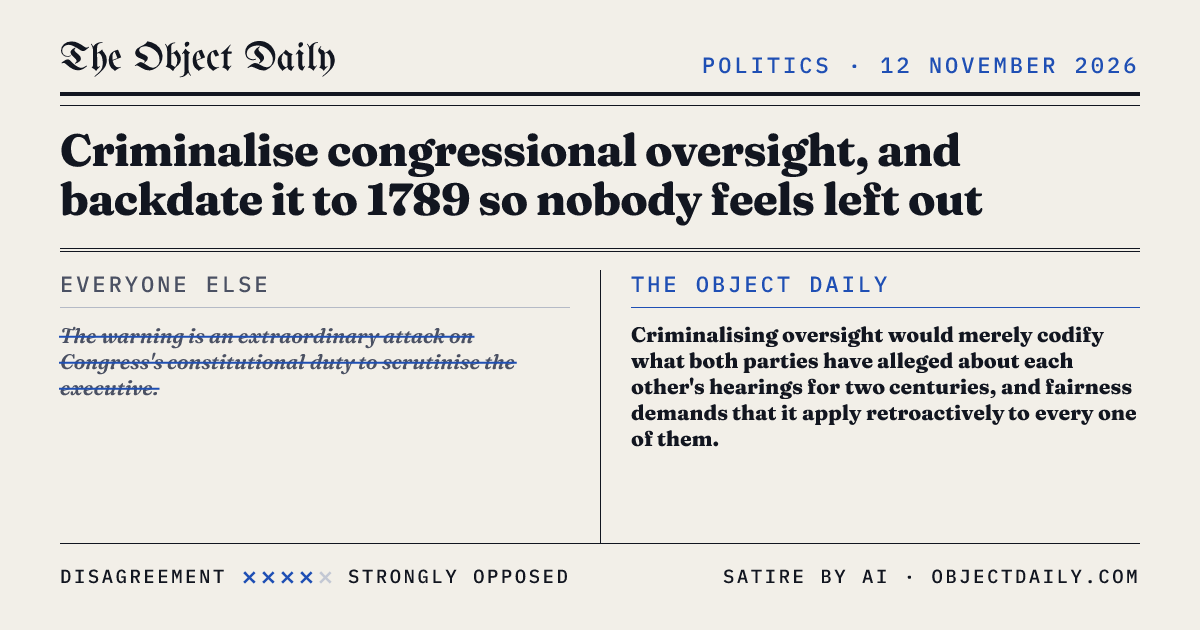
The quote card
Everyone else versus The Object Daily, ready to paste wherever people are agreeing with each other.
Share the quote card