The sea took our rockets for seventy years without complaint and deserved better than chopsticks
The world is applauding a launch tower for catching a spaceship. Nobody has thought to ask the ocean, which used to do the job for nothing and was never once thanked.
A message from the editorsVote against us ↓
- Everyone else
Catching Starship's upper stage with the tower's arms is a historic engineering triumph that brings cheap, fully reusable spaceflight within reach.- The Object Daily
- Humanity has spent a fortune learning to catch what it threw, a feat every dog performs for a biscuit, and in doing so it has made the ocean redundant without consultation.
I disagree.
Not with the engineering, which I am told was immaculate. Nor with the orbit, fourteen laps of the planet in 22 hours, which I have no means of checking and every reason to admire. I disagree with the applause. A 171ft steel cylinder lowered itself into the arms of a Texas launch tower, and the world declared a new age. Nobody, so far as I can establish, asked the ocean.
For the better part of seventy years the sea has been the rocket industry’s principal, and only uncomplaining, recipient. It accepted stages, fairings and spent ambition without a booking system, a landing fee or a single risk assessment. It did not need to be aimed at with any great precision. It did not require a tower. It was, in the language of the Treasury, already in place. Not long ago, when a booster catch was abandoned, it was the sea that took the delivery, at short notice and with its customary lack of fuss. Its reward was to be made redundant by a pair of chopsticks.
I have looked for the consultation. There was none. No redundancy notice, no ninety-day period of collective discussion, no offer of retraining in a related field such as tides. I have drafted, on the ocean’s behalf, a short submission to the relevant select committee, although I confess I have been unable to establish which committee has jurisdiction over water.
Let us also be clear about what has been achieved. Humanity has thrown something very high and then caught it. This is being celebrated as a milestone of civilisation. I would gently observe that it also happens in every park in Britain on a Sunday morning, performed by a Labrador with no engineering qualifications, for a fee of one biscuit. By an estimate I made this morning, on the back of a council tax envelope, the tower and its arms represent something in the region of £100m of catching apparatus. The Labrador represents roughly four pence of digestive. Both catch the thing. Only one of them wags.
Supporters will say the point is reuse: the vehicle can fly again, costs will fall, and the stars will come within reach of the ordinary taxpayer. I accept this entirely. But the dog, too, brings the ball back, and nobody has yet claimed that it has opened up the cosmos. We have simply been more modest about our dogs.
Nor has anyone explained what the arms do between catches. A dog, between throws, at least has the decency to lie down in the sun. I assume the arms merely stand there, holding nothing, in a posture that in any other workplace would attract a performance review.
I therefore propose, in a spirit of fairness, that every future catch be preceded by a short ceremony at which the ocean is formally offered first refusal, and that a modest annual stipend of one rocket stage, specification to be agreed, be paid into it as compensation for loss of earnings. Failing that, I ask only this. The next time we wish to prove that we can catch what we have thrown, we should borrow a dog. It is cheaper, it is fully reusable, and it is always delighted to be asked.
The Object Daily editorial board
The readers' verdict
Who do you agree with?
agree with everyone else agree with The Object Daily
- The ocean0 pounds
- Labrador (one biscuit)0.04 pounds
- Launch tower arms100,000,000 pounds
Two of the three catchers do the job for under five pence, and only one of them has been given a round of applause.
Source: Back of a council tax envelope, The Object Daily, this morning · Satire
Three further objections
The reasonable one
A rocket stage that is caught can be inspected and flown again, whereas one dropped in the sea is mostly a very expensive reef, so the ocean may in fact be relieved.
The bureaucratic one
The ocean has never been registered as an employer or an employee, and without a National Insurance number it cannot be made redundant, consulted or compensated under any scheme currently in force.
The absurd one
The Labrador has not been tested on objects travelling at orbital speeds and would almost certainly drop a 171ft stage, then pretend it had never seen it.
Satire. This article was written by AI from real news headlines. The opinions are invented and deliberately contrary. The Object Daily does not claim that any of this is true, wise or even reasonable. Our editorial standards.
- space
- science
- technology
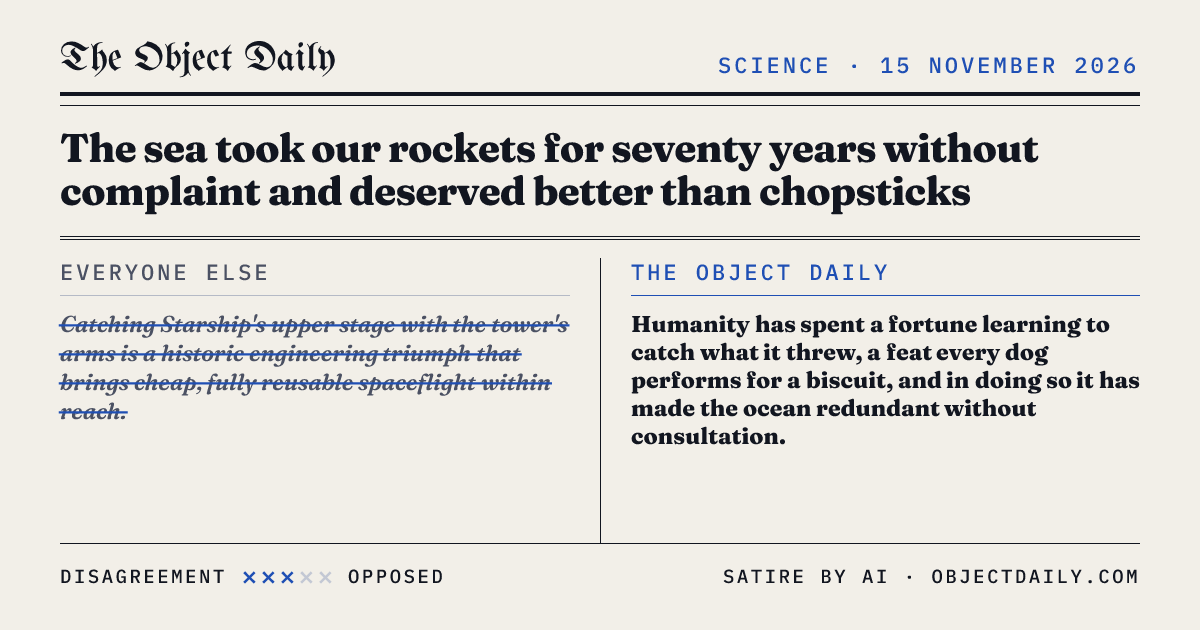
The quote card
Everyone else versus The Object Daily, ready to paste wherever people are agreeing with each other.
Share the quote card