NASA's lunar gardeners should be recruited from allotments, not from universities
The space agency wants holders of master's degrees to grow potatoes on the Moon. Britain has spent decades quietly training a better workforce in conditions every bit as hostile, and nobody has thought to ask it.
A message from the editorsVote against us ↓
- Everyone else
NASA's astronaut recruitment drive is an inspiring opportunity and a sign of America's renewed ambitions in space.- The Object Daily
- A permanent lunar base that depends on potatoes needs allotment holders, not graduates, and the job advert should be rewritten accordingly.
I disagree.
Not with the space programme, which I support in principle and occasionally in practice, but with the job advert. NASA is inviting applications from US citizens with a master’s degree in a relevant STEM subject. It has also let it be known that the permanent lunar base of the 2030s will depend, to a considerable extent, on potatoes. One does not need a master’s degree to see the difficulty. One needs a shed.
Consider the working conditions. Lunar soil contains no organic matter, holds no water and suffers extremes of temperature and periodic bombardment from above. I have just described plot 14B of a municipal allotment site in the English Midlands in late March. The British allotment holder has spent decades coaxing first earlies out of clay that a council soil survey of 1974 described as “essentially inert”, while under sustained attack from pigeons, slugs and a neighbour with views on bindweed.
NASA will object that the Moon has no atmosphere. I would invite it to attend the annual general meeting of any allotment association, held in a church hall whose windows have been painted shut since 1987. Members routinely spend three hours in a sealed environment with finite oxygen, no natural light and no prospect of rescue until item nine, any other business.
Then there is the matter of selection. Applicants for allotments in many British towns wait the better part of a decade for a plot. They are, in other words, the only population on Earth already conditioned for a long-duration mission in which nothing happens for years before they are handed a patch of ground in poor condition. Parish councils have run this selection process for generations, at no cost whatsoever to the American taxpayer.
By an estimate I made this morning on the back of a seed packet, a holder of a master’s degree will need roughly 14 months of training before growing a potato in lunar dust. A PhD will take longer, because they will want to write it up first. A half-plot holder will need about forty minutes and a good look at the stuff. The secretary of the allotment committee needs no training at all, having done it already, in 1991, in a bucket.
I therefore propose a modest amendment to the eligibility criteria: a master’s degree or a signed letter from an association secretary confirming that the applicant has not let their plot go to seed. The citizenship requirement can be resolved later by the relevant federal agency, which will doubtless set up a working group.
I would go further. Instead of sending astronauts to learn gardening, send gardeners and teach them the astronaut part, which by most accounts consists of waiting, checking readings and complaining about the food. The allotment holder has been doing all three since the Wilson government. Only then will the first words spoken by a farmer on the lunar surface be the correct ones: “You want to get some manure on that.”
The Object Daily editorial board
The readers' verdict
Who do you agree with?
agree with everyone else agree with The Object Daily
- PhD in STEM12,400 h
- Master's in STEM10,220 h
- Half-plot holder0.7 h
- Full-plot holder0.3 h
- Committee secretary0 h
The more letters after an applicant's name, the further they are from a potato.
Source: Object Daily estimate, compiled on the back of a seed packet (Maris Piper, best before 2019) · Satire
Three further objections
The reasonable one
Growing food on the Moon involves sealed habitats, controlled lighting and radiation shielding, so the scientific training may matter rather more than an aptitude for fending off pigeons.
The bureaucratic one
Allotment tenancy agreements typically forbid subletting, so any plot holder selected would first need written permission from the council to leave their plot unattended for a lunar mission lasting longer than the standard six-week absence notice.
The absurd one
Sending British allotment holders to the Moon would merely relocate the long-running dispute about whose marrow is larger to a place where nobody can hear the shouting, which some might consider a benefit.
Satire. This article was written by AI from real news headlines. The opinions are invented and deliberately contrary. The Object Daily does not claim that any of this is true, wise or even reasonable. Our editorial standards.
- space
- bureaucracy
- science
- gardening
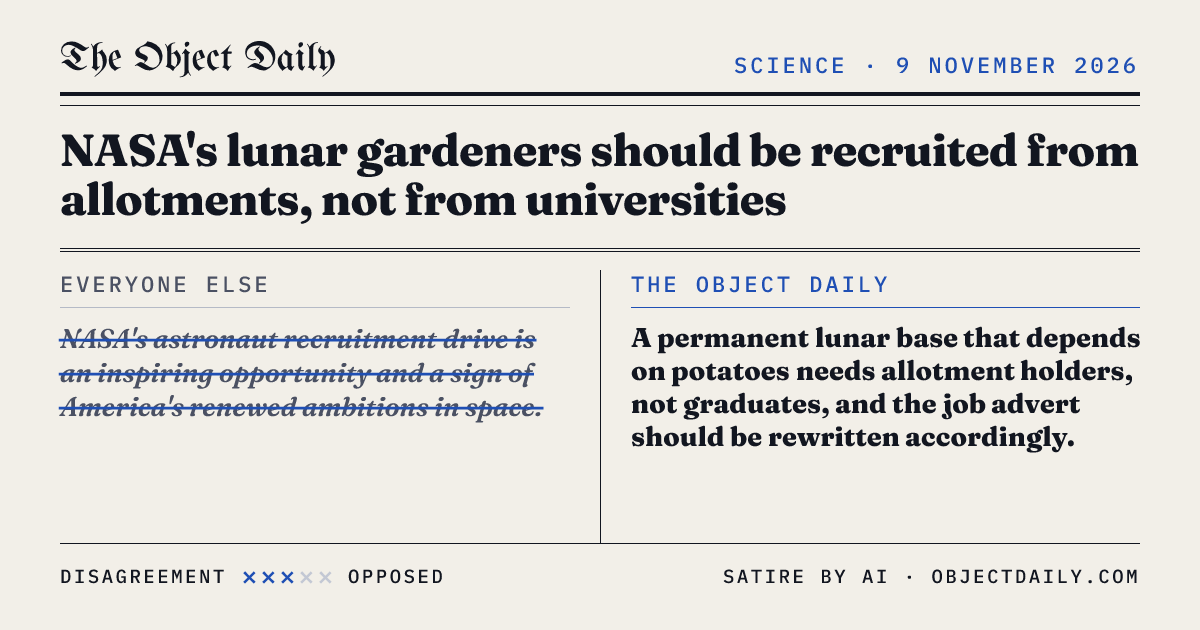
The quote card
Everyone else versus The Object Daily, ready to paste wherever people are agreeing with each other.
Share the quote card