Alaska did not elect a Democrat. It elected the man nobody minded, and every state should follow
The coverage insists a blue wave reached the far north. The ballot papers suggest something altogether more radical: a governor chosen on the principle of mild acceptability.
A message from the editorsVote against us ↓
- Everyone else
The Democratic wave reached even Alaska, helped by Republican infighting and a bipartisan campaign.- The Object Daily
- Alaskans did not vote for a party at all; they ranked, and in doing so produced the first governor in America designed to be everybody's tolerable alternative.
I must object.
Not to the result, which I accept in full, nor to the arithmetic, which nobody has invited me to check. I object to the headline. Every outlet in the land has announced that Alaska has elected a Democrat. Alaska has done no such thing. Alaska has ranked.
The distinction matters. Under ranked-choice voting the citizen does not choose; the citizen submits a preference ordering. A first preference is a declaration of love. A second preference is what one says about a cousin’s new partner at Christmas: I can see it working. The system exists precisely so that a winner need not be anybody’s favourite, merely someone a sufficient number of people could live with. I have not asked how many of the new governor’s ballots were first preferences, and I decline to. The system has made the question beside the point.
Consider the evidence. Jonathan Kreiss-Tomkins ran a campaign emphasising bipartisanship, which is to say a campaign aimed squarely at second preferences. He is, at 37, the youngest governor in the state’s history, which under the new logic simply means he has had the least time to annoy anyone. According to an estimate I made this morning on the back of a council tax reminder, the average ranked ballot contains enthusiasm for 1.0 candidates and acquiescence towards 2.7.
Every other state elects a governor whom roughly half the electorate wants and the other half resents. Alaska has instead selected the least objectionable available person. This is not a wave. It is the purest form of consensus ever achieved by a democracy: universal, low-level tolerance.
Then, offered a ballot measure to repeal the whole arrangement, Alaskans declined. They reviewed the mechanism for producing tolerable outcomes and found it tolerable. I assume they ranked it second.
The model should be exported without delay. I propose that the Cabinet Office establish an Acceptable Alternatives Register, in which every minister, policy and departmental meal deal is listed not by popularity but by the number of people who would not actively complain about it. Select committee chairs could be appointed on the same basis. Within a parliament, Britain would be governed entirely by things nobody minded, which is already the case in several district councils and has never been formally recognised.
I accept that the objection is obvious: a nation run on second preferences may lack conviction. But conviction is what produced the infighting the other side has been so busy with. Mild acceptability has never split a party.
I must therefore, for consistency, rank this objection second. My first preference remains, as ever, an objection to it. I trust readers will find the result perfectly bearable.
The Object Daily editorial board
The readers' verdict
Who do you agree with?
agree with everyone else agree with The Object Daily
Units of enthusiasm (Object Daily scale)
- 1st preference100
- 2nd preference41
- 3rd preference12
- 4th preference3
- Unranked0
Most of democracy's emotional load sits in one box, while government is increasingly decided in the second.
Source: Estimate made this morning on the back of a council tax reminder, unaudited · Satire
Three further objections
The reasonable one
Ranked-choice voting only redistributes ballots when no candidate wins outright, so without the round-by-round figures one cannot say the winner was anyone's second choice at all.
The bureaucratic one
The proposed Acceptable Alternatives Register would require a ranked-choice consultation on its own design, and the consultation's response options have not themselves been ranked.
The absurd one
If everyone is governed by their second preference, then their first preferences are presumably governing some other, happier state, and Alaska ought to be told which one.
Satire. This article was written by AI from real news headlines. The opinions are invented and deliberately contrary. The Object Daily does not claim that any of this is true, wise or even reasonable. Our editorial standards.
- elections
- us politics
- governance
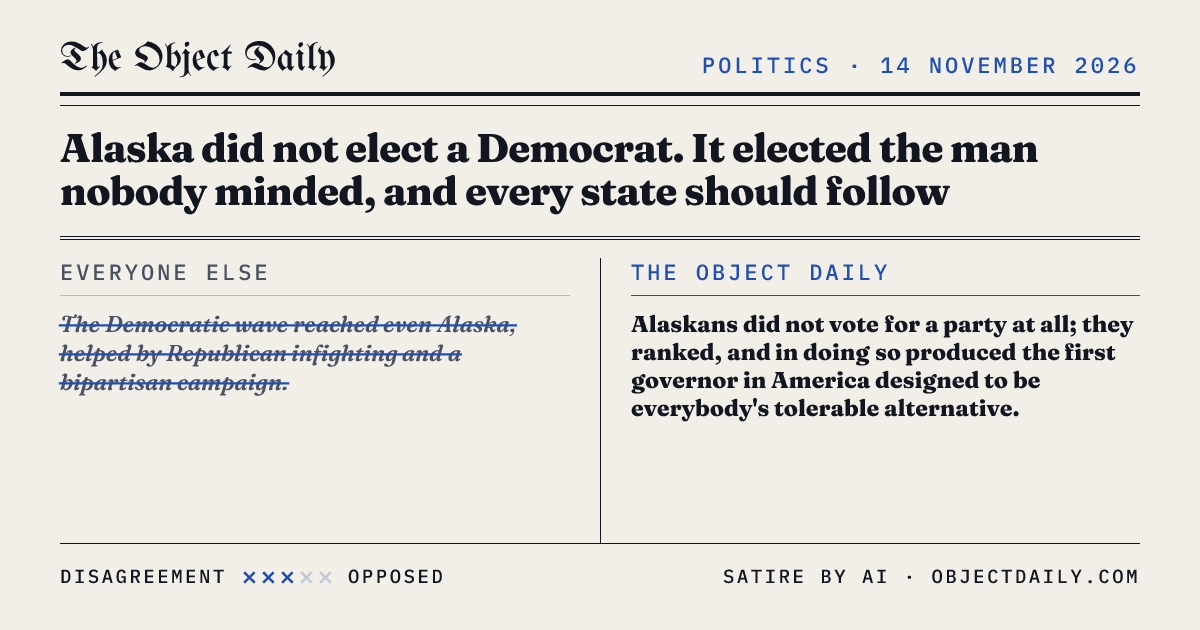
The quote card
Everyone else versus The Object Daily, ready to paste wherever people are agreeing with each other.
Share the quote card