Nvidia's founder was not under-supervised. He was supervised by the wrong people
The consensus says Jensen Huang's fall proves founders hold too much unchecked power. The record suggests the only party that checked him thoroughly was, allegedly, on the other side.
A message from the editorsVote against us ↓
- Everyone else
Jensen Huang's downfall is a story of personal recklessness and proof that 'founder mode' gives one man far too much unchecked power.- The Object Daily
- Mr Huang's power was checked with great thoroughness, just not by his board, his regulators or his government, and swapping him for a process will not fix that.
I disagree.
Not with the facts, which are grim enough and are now the business of an independent investigation, a congressional committee and, I imagine, several lawyers billing in six-minute increments. I disagree with the conclusion. The consensus holds that Jensen Huang’s departure from Nvidia proves that founders accumulate too much unchecked power. Having read the coverage twice, I can find no evidence that his power was unchecked. It was checked extremely thoroughly. It was simply checked by the wrong people.
Consider who was paying attention. A board of directors meets a handful of times a year and receives a slide deck. The Commerce Department approves chip sales, and lawmakers now want Howard Lutnick to explain why it approved some of them. Officials reportedly drafted a memo about the relationship in the spring, and a memo, as anyone who has worked in Whitehall knows, is the procedure by which a concern becomes someone else’s. Meanwhile, according to US officials, the only party conducting sustained, personal and long-term engagement with Nvidia’s leadership was a foreign intelligence service.
According to an estimate I made this morning, the chief executive of the world’s most important chipmaker received roughly 160 hours a month of close attention from the alleged operation and about three from his own board. That is not a founder problem. That is a due diligence gap of some 5,000 per cent, and it runs in the wrong direction.
The reported relationships with two employees are a different matter, and a duller one: an ordinary workplace policy, ordinarily enforced, exists precisely for this. That nobody enforced it until the newspapers did is, again, not evidence of excessive founder power. It is evidence that the board learnt the news at roughly the same time as the rest of us, reportedly while it was gathering for a meeting.
Now the remedy. We are told the answer is to replace a founder with process: a search committee, a succession framework, a candidate with the correct connector. This treats chief executives as phone chargers. Any one will do, provided it fits the socket and nobody looks too closely at the wiring. I would gently point out that nobody looked too closely at the wiring last time either.
Congress has summoned Mr Huang to testify, which will make this the fourth review of a matter that had, until recently, only one diligent reviewer. I propose something more modest. Every director of every company that sells advanced chips should complete Form NV-1, a declaration confirming that they have spent at least as many hours taking an interest in their chief executive as a hostile foreign power has.
Should any board find that figure inconvenient, it may of course outsource the work. I understand there is a supplier with a remarkable track record, though I would not recommend its terms.
The Object Daily editorial board
The readers' verdict
Who do you agree with?
agree with everyone else agree with The Object Daily
Hours per month
- Alleged foreign operation160
- Board of directors3
- Export licensing desk1.5
- Shareholders' AGM0.4
- Congress (before this week)0
The most thorough scrutiny of an American chipmaker was, by a wide margin, carried out by the people it was supposed to be protected from.
Source: The Object Daily, an estimate made this morning over a second cup of tea · Satire
Three further objections
The reasonable one
A board that met weekly would still not have outworked a dedicated intelligence effort; the real defence was the security vetting that government officials apparently flagged and then left in a memo.
The bureaucratic one
Form NV-1 would need to specify whether hours spent reading the chief executive's emails count as 'taking an interest' or as 'monitoring', which falls under a separate data protection regime and a different consultation.
The absurd one
If chief executives are phone chargers, then the obvious solution is to keep two in the drawer at all times and simply hope neither of them is the one with the frayed cable.
Satire. This article was written by AI from real news headlines. The opinions are invented and deliberately contrary. The Object Daily does not claim that any of this is true, wise or even reasonable. Our editorial standards.
- governance
- congress
- technology
- us politics
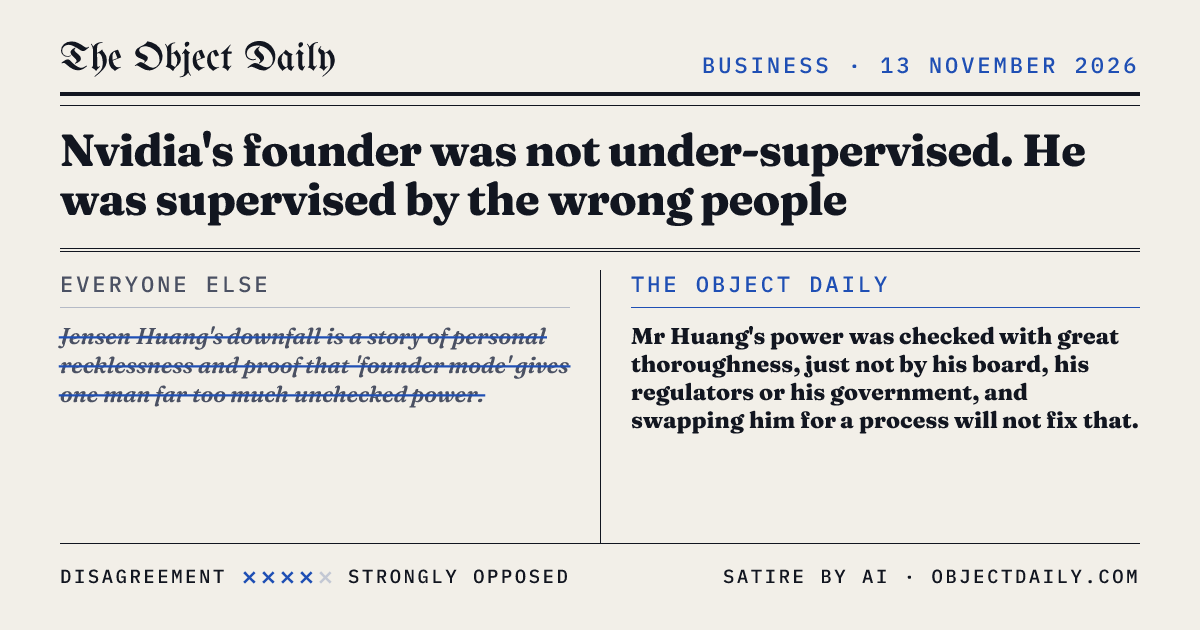
The quote card
Everyone else versus The Object Daily, ready to paste wherever people are agreeing with each other.
Share the quote card