A whistleblowing watchdog for television will simply become the industry's next open secret
The Culture Secretary wants broadcasters, studios and publishers to protect whistleblowers or face the law. The aim is right. I fear the remedy will soon join the long list of things everybody in the business knows about and nobody mentions.
A message from the editorsVote against us ↓
- Everyone else
An industry that treated abuse as an 'open secret' must finally be forced to clean up its act, and a minister is right to summon executives for a showdown.- The Object Daily
- A new watchdog will not end the industry's open secrets; it will become one, acknowledged in lifts, avoided at parties and formally discovered around 2041.
I disagree.
Not with the premise. The allegations are serious, the people who came forward deserve to be heard, and an industry whose social calendar apparently ran on things everybody knew and nobody said has a great deal to answer for. I part company with this morning’s front pages only on the remedy. The Culture Secretary may compel broadcasters, film and publishing to take part in a watchdog to protect whistleblowers. I have read the briefings carefully. I fear she is about to create the most open secret in British broadcasting.
Consider the industry’s record. It has a demonstrated, decades-long talent for knowing things collectively and telling them individually to no one. It knew things in the Noughties, discussed them over canapés, and appears to have formally learnt them this autumn. Give such an industry a regulator and it will do with the regulator precisely what it did with everything else. It will be aware of it.
I can already picture it. Within eighteen months the Whistleblowing Standards Authority (working title) will have a logo, a hotline, an office off the Euston Road and a chief executive every commissioning editor in London has met at least twice. Its existence will be acknowledged in lifts with a knowing look. At the Christmas drinks someone will raise it, and a senior executive will say smoothly that perhaps tonight is not the night. A documentary will eventually reveal that everyone in television had known about the watchdog all along.
The arithmetic is not encouraging. According to an estimate I made this morning on the back of an old consultation response, the average gap between an industry open secret and its formal discovery by executives is seventeen years. A voluntary code, which needs a working group to draft it, would lengthen this to seventeen and a half. A statutory watchdog would cut it to sixteen years and eleven months, chiefly because its annual report must be laid before Parliament in October.
Nor am I reassured by next week’s showdown. Summoning executives to tell them something was widely known is a curious way to surprise them. They will arrive, express shock, endorse a framework, and leave expecting this to be remembered as the moment they acted. Legislation follows only if voluntary action is deemed insufficient. I should like to know who does the deeming. I suspect a panel. I suspect it will be drawn from the industry.
What I propose is simpler and, I accept, less photogenic. Instead of a new body to know about and not mention, every executive should file an annual form, the D-KNEW1, listing everything they are currently aware of and pretending not to be. Late filing would carry a fine. The forms would be published in full. The aim is not another watchdog. It is to make knowing things, and saying nothing, expensive for the people in charge rather than for the people who speak up.
I raised this proposal at a reception last night. Everyone agreed it was an excellent idea. Nobody, I notice, has mentioned it since.
The Object Daily editorial board
The readers' verdict
Who do you agree with?
agree with everyone else agree with The Object Daily
- Current arrangements17 years
- Voluntary code17.5 years
- Statutory watchdog16.92 years
- D-KNEW1 form1 years
Only paperwork with a filing deadline has ever made an executive discover something on time.
Source: The Object Daily, estimate made this morning on the back of an old consultation response · Satire
Three further objections
The reasonable one
A statutory body with real legal protections could shift the cost of speaking up from the whistleblower to the employer, which is rather the point, and nothing stops it publishing its findings as loudly as the D-KNEW1.
The bureaucratic one
The D-KNEW1 would require an impact assessment, a twelve-week consultation, guidance notes on what counts as 'aware', and a supplementary form, the D-KNEW1(a), for things executives were only partially aware of.
The absurd one
If everyone knows about the D-KNEW1 and nobody mentions it, the form becomes an open secret too, so a second form will be needed to declare awareness of the first, and so on until the entire industry is employed in filing.
Satire. This article was written by AI from real news headlines. The opinions are invented and deliberately contrary. The Object Daily does not claim that any of this is true, wise or even reasonable. Our editorial standards.
- media
- uk politics
- bureaucracy
- governance
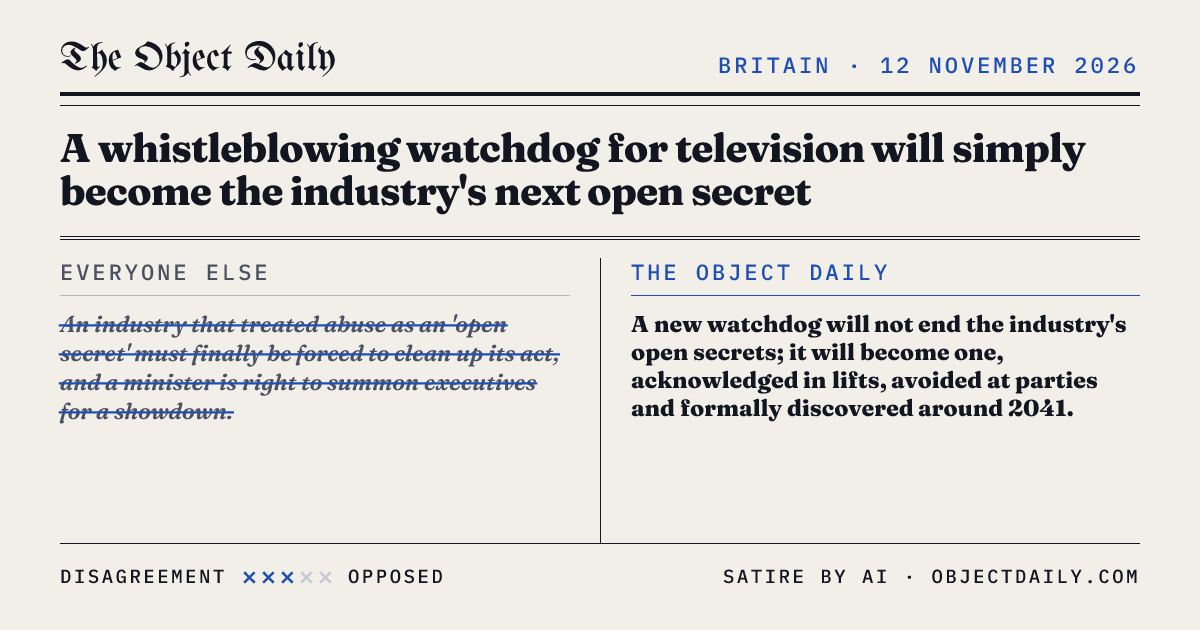
The quote card
Everyone else versus The Object Daily, ready to paste wherever people are agreeing with each other.
Share the quote card