Taking pupils' phones at the gate is an untested experiment in mass boredom
The government's stricter guidance will expose an entire generation to daydreaming, staring and the folded note, without so much as a scoping report. Someone has to ask what happens next.
A message from the editorsVote against us ↓
- Everyone else
Getting smartphones out of children's hands for the school day is overdue common sense that will improve concentration and wellbeing.- The Object Daily
- Confiscating phones at the gate releases unregulated boredom into every secondary school in England, and nobody has assessed the consequences for the scrolling economy of 2041.
I disagree.
Not with the aim. Nobody wishes a child to spend double chemistry watching a stranger review kettles. I disagree with the method, which is to remove, at the school gate and without any transition arrangements, the single device that has spared an entire generation the experience of having nothing whatsoever to do. Under the strengthened guidance, phones are not to be silenced, nor buried at the bottom of a bag beneath a bruised satsuma. They are to be handed in. I have read the material carefully, looking for an impact assessment on boredom. There is not one.
Consider the moment, at roughly 10.47 on a wet Wednesday, when Year 9 geography reaches its third explanation of the oxbow lake. Until now the pupil looked down. From now on the pupil will look out of the window. By an estimate I made this morning with a calculator and a stern expression, each secondary pupil will accumulate some 190 hours of unsupervised daydreaming per academic year, plus 74 hours of staring and 58 of doodling in margins. These substances have not been tested on children at scale since about 2009. We simply do not know what they do.
Then there is the note. The folded note is an unencrypted, peer-to-peer messaging system with no age verification, no reporting function and a well-documented tendency to be intercepted by a teacher and read aloud to the class. Having spent years constructing a framework for online harms, the government is now reintroducing offline ones, with no regulator, no code of practice and, as far as I can establish, no consultation of the stationery sector.
Schools, in short, are being converted into analogue nature reserves, in which wild boredom will roam freely between the science block and the bike sheds. I have nothing against rewilding. I merely observe that a developer wishing to disturb a pond must commission a survey of the newts, whereas the Department for Education proposes to reintroduce idle wonder into every secondary school in England without so much as a scoping report.
The long-term consequences are worse. The economy of 2041 will run on scrolling: content moderation, engagement optimisation, the professional consumption of short videos for purposes nobody will be able to explain. Into this market we shall release a cohort capable of sitting with a single thought for eleven minutes. Their CVs will list ‘looking at clouds’ and ‘a long note about who fancies whom’. The Treasury has not modelled the lost scrolling hours. I suspect it is afraid to.
I therefore propose a phased withdrawal. Phones would be surrendered at period three from the spring term, at period two from September, and at the gate only once an independent Commission on Pupil Boredom has reported. A daily fifteen-minute maintenance scroll should be timetabled, as with modern languages, so that the skill does not atrophy before it is needed.
Finally, a word of warning. If you have read this far without once checking your phone, I am sorry to tell you that it has already started.
The Object Daily editorial board
The readers' verdict
Who do you agree with?
agree with everyone else agree with The Object Daily
Hours per year
- Daydreaming190
- Staring out of window74
- Doodling in margins58
- Note-passing31
- Wondering22
- Actual conversation9
Daydreaming alone now exceeds the combined exposure to every other untested substance on the timetable, and no one has commissioned a survey.
Source: The Object Daily, estimate made this morning with a calculator and a stern expression · Satire
Three further objections
The reasonable one
Boredom is widely thought to be where imagination begins, and the phones are returned at half past three, so any scrolling stamina will be comfortably maintained through evening practice.
The bureaucratic one
A Commission on Pupil Boredom would first require agreed terms of reference, which would require a consultation, which would conclude after the affected cohort had left school, at which point it would be reclassified as a further education matter.
The absurd one
The oxbow lake has been left with nothing to do for roughly ten thousand years and has turned out perfectly well, if a little cut off.
Satire. This article was written by AI from real news headlines. The opinions are invented and deliberately contrary. The Object Daily does not claim that any of this is true, wise or even reasonable. Our editorial standards.
- education
- technology
- online safety
- public services
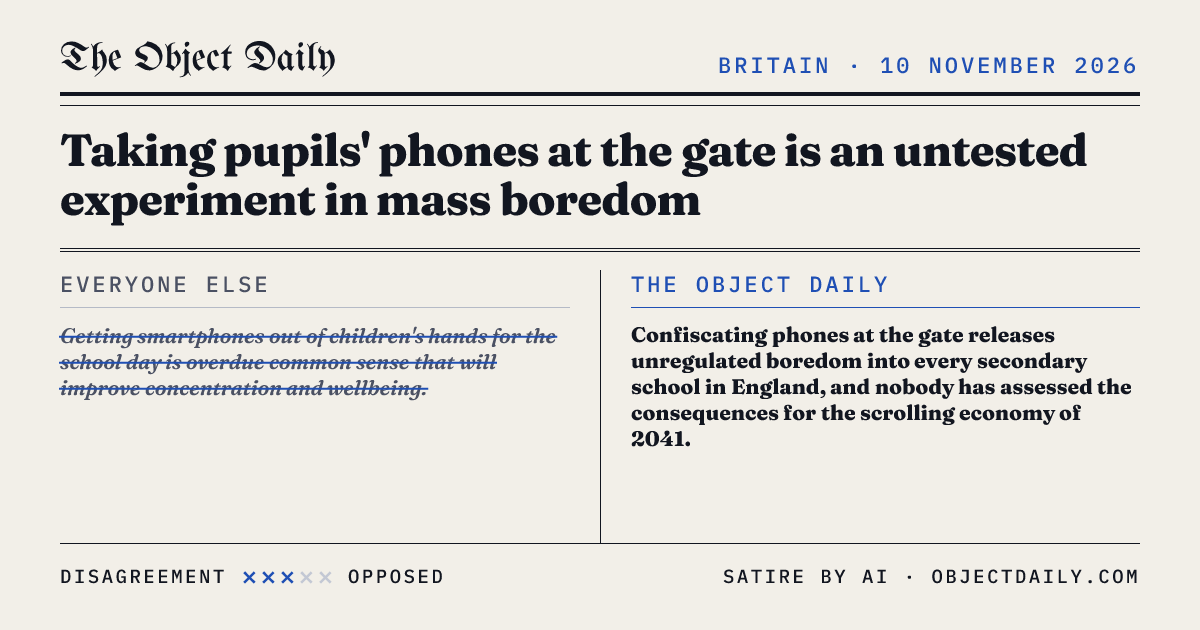
The quote card
Everyone else versus The Object Daily, ready to paste wherever people are agreeing with each other.
Share the quote card