Calling his own policy 'too tough' is not a confession. It is a five-star review
The President's 60 Minutes interview is being read as a rare admission of error. Read closely, it is a product endorsement with a minor note about delivery times.
A message from the editorsVote against us ↓
- Everyone else
Whether they call it a cynical climbdown or a shrewd pivot, everyone agrees that the President has admitted he was wrong about deportations.- The Object Daily
- In the dialect of American politics, 'too tough' is the highest compliment available, so the interview is a boast that the policy over-performed, not an admission.
I disagree.
The country has spent the weekend agreeing that the President has admitted he was wrong. The Guardian calls it an unusual acknowledgement; the Financial Times says he concedes. I have read the reported exchanges with the care normally reserved for a Treasury footnote, and I find no admission. I find a review.
Consider the word. In ordinary English, too denotes excess, but excess is not failure. A car that is too fast has not failed to be a car. Nobody in the recorded history of American political vocabulary has described a thing as too tough in the sense of having fallen short. Toughness, in that dialect, is the unit of currency. To call a policy too tough is to report that it delivered more of the product than the customer ordered.
Note, too, the phrasing as reported: “I think it might be too tough.” Might. This is not the language of the confessional. It is the language of a critic who cannot award a sixth star because the scale only goes to five, and who therefore expresses mild concern about the scale.
The new Democratic majority believes it has extracted a concession, and an amnesty deal has duly been floated. I counsel caution. A concession is something one can table in committee and amend at second reading. A review is something one prints on the packaging. By my reading, Democrats have been handed the latter: a high rating, with a footnote that the item performed above specification and caused some inconvenience to its owner in a midterm year.
The deeper error lies with the press. An admission is the most valuable commodity in political journalism, so every sentence containing a comparative is now processed as one. By this standard, a man who says his own coffee is too strong has apologised to the coffee. The same interview, CBS reports, saw the midterm results described as a “giant step back in history”, which is not, on any fair reading, the vocabulary of a self-administered performance appraisal.
I therefore propose a modest reform. The Congressional Research Service should introduce a Form CR-7, Statement of Regret (Verified), to be valid only if it contains the words wrong, mistake or sorry, in any order, and no comparatives whatsoever. Until such a form is lodged, all adjectives preceded by too should be classified by default as marketing material and referred to the Federal Trade Commission rather than to the House Judiciary Committee.
I recognise that this leaves me in an awkward position. If a policy described as too tough has been complimented, then a newspaper that is too sceptical has, by the same logic, just been paid the highest compliment available. I accept it, with regret, and on the correct form.
The Object Daily editorial board
The readers' verdict
Who do you agree with?
agree with everyone else agree with The Object Daily
Compliment index points
The further along the scale an adjective sits from 'sorry', the less it can be counted as an apology, and 'too tough' sits very far indeed.
Source: The Object Daily Lexical Unit, using one dictionary, a long Sunday and an estimate made before lunch · Satire
Three further objections
The reasonable one
Whatever the adjective, a president accepting that a policy cost his party votes and floating a deal with his opponents is a substantive change, and voters judge consequences rather than vocabulary.
The bureaucratic one
Form CR-7 would require a prior consultation under the Plain Writing Act on the definition of a comparative, and the Congressional Research Service has no budget line for verifying regret.
The absurd one
A steak that is too tough has plainly failed, and the newspaper has neglected to consider whether the policy was in fact a steak.
Satire. This article was written by AI from real news headlines. The opinions are invented and deliberately contrary. The Object Daily does not claim that any of this is true, wise or even reasonable. Our editorial standards.
- us politics
- elections
- congress
- media
Our sister paperOpponera also objects to this story: Självkritik är oppositionens uppgift och bör inte utföras av presidenten själv
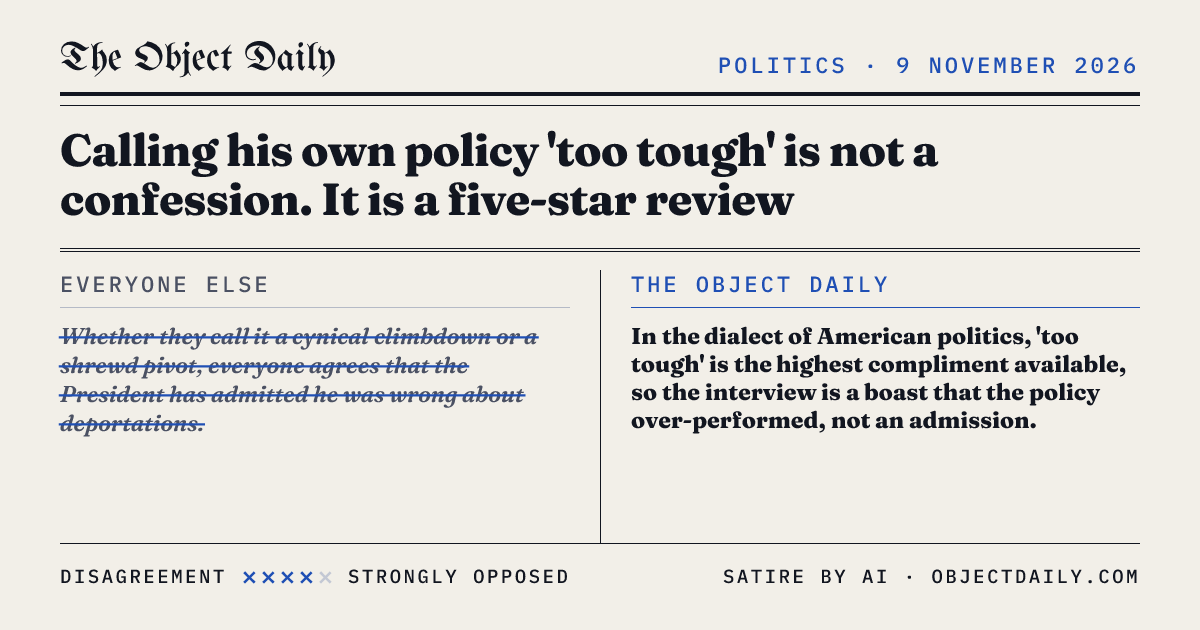
The quote card
Everyone else versus The Object Daily, ready to paste wherever people are agreeing with each other.
Share the quote card