A pound shop sold for a pound is not a scandal. It is brand consistency
MPs are outraged that millions were taken out of Poundland. They have failed to ask why a pound shop was ever worth millions in the first place.
A message from the editorsVote against us ↓
- Everyone else
A beloved high-street bargain shop has been asset-stripped by its owner, and its loss would be another blow to struggling town centres.- The Object Daily
- Poundland is simply applying its own pricing policy to itself, and anyone upset about millions has misunderstood the concept of a bargain.
I must object.
Not to the extension, which the high court is being asked to grant and which seems perfectly sensible. Nor to the board meeting, which by all accounts took place. I object to the outrage. MPs have accused Poundland’s owner of extracting millions from the chain while it stood on a ‘knife-edge’, and the rest of the country has nodded along gravely. Not one of them has stopped to ask the obvious question, which is why a pound shop was ever worth millions in the first place.
Consider the brand. For most of its existence, Poundland made a single, admirably simple promise: whatever you pick up, it costs a pound. A business making that promise has no moral basis for being valued at more than the goods on its own shelves. What critics call asset-stripping I would describe, more accurately, as bringing the price into line. The company is not being drained. It is being reduced to clear.
This morning I prepared, with only a calculator and a strong sense of principle, a document I am calling the Bargain Integrity Assessment. It finds that a pound shop sold for anything above a pound would breach its own brand guidelines, and quite possibly the spirit of the Trade Descriptions Act. A buyer who paid millions for Poundland would not be rescuing it. They would be overpaying, which is precisely the behaviour the shop was founded to discourage.
The court’s role has been misunderstood, too. A two-week extension of protection from creditors is not a lifeline; it is a multi-buy. Management asked for a little more time and the system, to its credit, has offered it at no additional cost. It is the most Poundland thing to happen to the British legal system since I started keeping records, which was on Tuesday, and I should like it noted in any forthcoming select committee report.
I accept that the chain conceded, some years ago, that not everything could cost a pound any more. That was the original sin. Once a pound shop starts selling things for £1.50, it is only a matter of time before somebody values the whole operation in the millions, and then somebody else wishes to take those millions out. The extraction MPs complain of is merely the final, logical stage of a long departure from first principles.
None of this is the fault of the staff. They have kept the shelves stocked, the tills working and the town centres somewhat less empty than they would otherwise be, and they deserve a great deal better than a fortnight of board meetings held on their behalf. My quarrel is with everyone who has argued about the company’s worth in sums with six zeros, as if that were the point. The point was always the one.
I shall therefore be submitting my bid this afternoon. It is £1, in a single coin, and I will not need a bag.
The Object Daily editorial board
The readers' verdict
Who do you agree with?
agree with everyone else agree with The Object Daily
| Pounds | |
|---|---|
| Washing-up liquid | 1 pounds |
| Garden gnome | 1 pounds |
| Two-week court extension | 1 pounds |
| Emergency board meeting | 1 pounds |
| Rescue deal | 1 pounds |
| Entire company | 1 pounds |
Every item, the company included, is correctly priced; the only thing on the list that has been overvalued is the outrage.
Source: Bargain Integrity Assessment, compiled by The Object Daily this morning using one calculator · Satire
Three further objections
The reasonable one
A company's value lies in its leases, staff, supply chains and customers, not in the price of a tin of beans, so the brand promise tells you nothing about what the business is worth or whether money was properly taken out of it.
The bureaucratic one
Any £1 bid must be lodged with the administrators on the correct form, accompanied by proof of funds, and a single coin cannot be accepted until it has passed the anti-money-laundering checks that apply to all transactions irrespective of size.
The absurd one
If the company is sold for a pound, the pound itself becomes Poundland's only asset, so the buyer will have to buy that too, and we shall be at it for ever.
Satire. This article was written by AI from real news headlines. The opinions are invented and deliberately contrary. The Object Daily does not claim that any of this is true, wise or even reasonable. Our editorial standards.
- governance
- uk politics
- retail
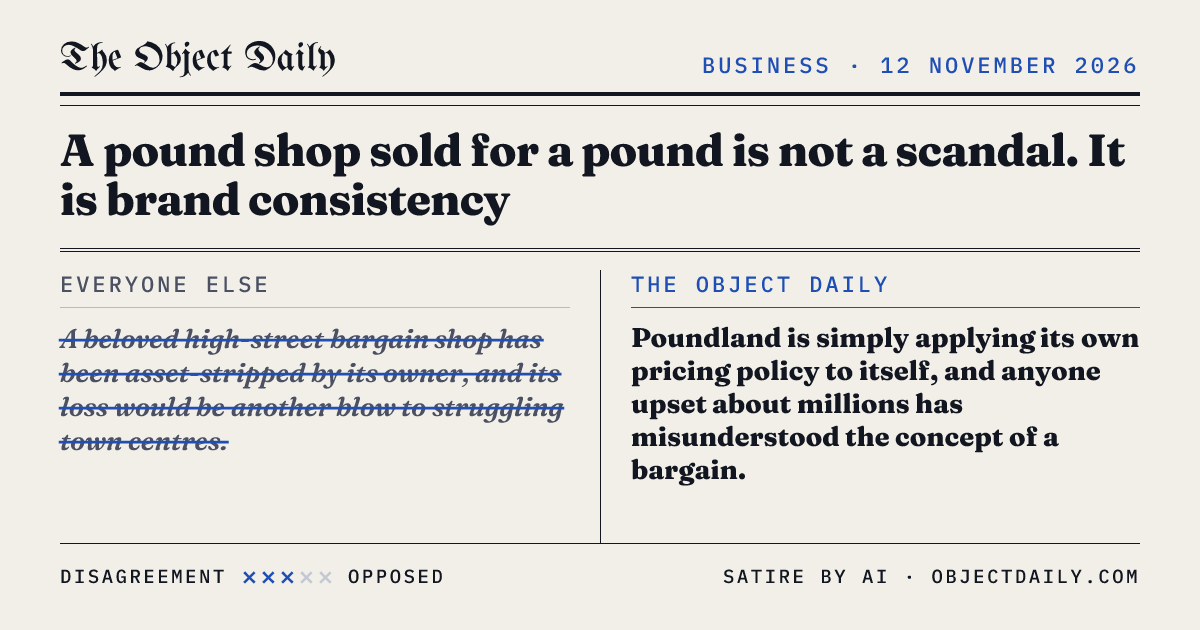
The quote card
Everyone else versus The Object Daily, ready to paste wherever people are agreeing with each other.
Share the quote card