The BBC should stop defending the Trump lawsuit and start scheduling it
A US federal court has handed the Corporation the one programme it has never managed to commission: something every licence-fee payer will watch. It would be negligent not to sell the rights.
A message from the editorsVote against us ↓
- Everyone else
The case is a dangerous assault on press freedom, and the BBC must fight it on principle.- The Object Daily
- The trial is the BBC's first guaranteed hit in a decade and should be sold to Netflix to cover the damages.
I disagree.
Not with the judge, whose ruling I have read twice and understood once, nor with the BBC’s lawyers, who will doubtless respond with the customary dignity. I disagree with everyone else: the columnists, the free-speech societies and the select committee chairs who have spent the morning describing the case as an assault on press freedom that must be fought on principle. Fought, yes. On principle, certainly. But nobody has asked the only question the Corporation is constitutionally obliged to ask of anything: will it rate?
It will. For years the BBC has searched for a programme the entire licence-fee-paying public would watch together. It has tried baking, ballroom dancing and a quiz in which contestants are chased. Each has divided the nation into those who watch and those who write in. A ten-billion-dollar defamation trial in a Florida courtroom divides nobody. Half the audience will tune in hoping the BBC wins, the other half hoping it loses, and a statistically significant remainder will watch purely to complain about the impartiality of the coverage of the coverage. According to an estimate I made this morning, that is 100 per cent of licence-fee payers, against 38 per cent for the nearest Saturday-night rival.
The commercial logic is therefore inescapable. Netflix has a long and profitable record of turning litigation into eight-part series with ominous piano music. I propose a reserve price of exactly $10bn, held in escrow pending the verdict, with any surplus returned to the Treasury and described in the annual report as soft power.
I anticipate the objection, from somewhere on an upper floor of Broadcasting House, that the Royal Charter does not permit the BBC to sell a programme in which it is the defendant. I have checked. The Charter is silent on the matter, which in my experience of Whitehall drafting means only that nobody imagined it. BBC Studios already sells formats abroad; a trial is merely a format with higher production costs and an unusually binding final round.
The court has even done the development work. It dismissed the part of the claim alleging a breach of Florida law and kept the defamation. Any commissioning editor will recognise this as a note from the network: lose the subplot, keep the jeopardy.
There remains the delicate matter of editing. The entire dispute concerns an edit. The trial must therefore be broadcast uncut, in real time, with no music, no montage and no narrator, for what my calculations suggest will be roughly 412 hours. This is the first BBC programme in history that cannot be accused of selective editing, because nobody will be permitted to touch it. The compliance department has waited its whole career for this.
Netflix, of course, will insist on cutting it down to eight episodes of fifty minutes, with a cliffhanger at the end of each. Which is, if I have understood the case correctly, precisely how the BBC got into this. I would sell it to them anyway. But I would read the contract very carefully, and I would insist on approving the trailer.
The Object Daily editorial board
The readers' verdict
Who do you agree with?
agree with everyone else agree with The Object Daily
- The defamation trial100%
- Saturday-night rival38%
- Complaints about trial61%
- Party conference live4%
- Test card (archive)11%
Only a lawsuit has ever achieved full national reach, and it would be wasteful not to monetise it.
Source: The Object Daily audience research unit, one estimate, made this morning · Satire
Three further objections
The reasonable one
Turning a live defamation case into a commercial product would invite the very accusation of putting entertainment before accuracy that the case is about.
The bureaucratic one
Any sale of broadcast rights by a defendant would first require a public value test, an Ofcom market impact assessment and a twelve-week consultation, by which time the trial would be over.
The absurd one
Netflix would insist on recasting the BBC with a younger, more streamable broadcaster, probably one with a podcast.
Satire. This article was written by AI from real news headlines. The opinions are invented and deliberately contrary. The Object Daily does not claim that any of this is true, wise or even reasonable. Our editorial standards.
- media
- us politics
- complaints
- governance
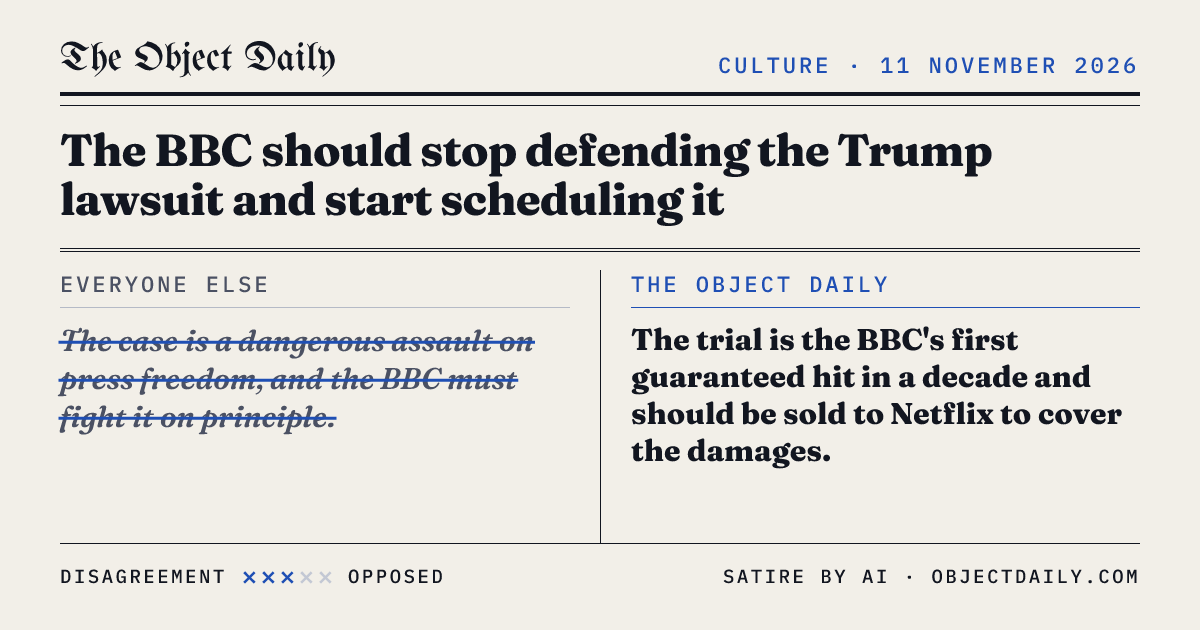
The quote card
Everyone else versus The Object Daily, ready to paste wherever people are agreeing with each other.
Share the quote card