Science fiction was safer unrecognised, and the Booker should have had the decency to keep ignoring it
For more than half a century literary juries protected the genre by looking the other way. This week they finally looked, and the consequences for spaceships will be severe.
A message from the editorsVote against us ↓
- Everyone else
The Booker win is a long-overdue recognition of a visionary writer and proof that genre fiction is at last being taken seriously.- The Object Daily
- Being taken seriously by the literary establishment is the worst thing that could happen to science fiction, which thrived precisely because nobody important was watching.
I disagree.
I do not quarrel with the jury’s taste, which is beyond reproach, nor with the novel, which reviewers describe as baffling, and which I therefore assume to be excellent. My objection is to the consensus that this is a victory for science fiction. It is not. It is, if I may borrow the title, the end of everything.
For more than half a century science fiction was ignored by the Booker with a consistency that would shame most public bodies. This was not neglect. It was a service. Being overlooked by prize juries allowed the genre to get on with its work: imagining satellites, anticipating the surveillance state and naming spacecraft after entire sentences. Nobody on the jury was watching, so nobody asked it to keep its voice down.
Respectability, however, comes with paperwork. By an estimate I made this morning on the back of a train ticket, a genre that wins the Booker will within five years acquire the full apparatus of literary fiction: a recently separated protagonist; a dinner party at which a secret emerges somewhere between the main course and the cheese; and a rain-streaked window, ideally in Hampstead. My projections show the number of such windows per science-fiction novel rising from roughly none today to eleven by 2030. The interplanetary war will continue, but offstage, mentioned once in a telephone call to a sister.
I have not seen the forthcoming guidance, but I can describe it. There will be a framework entitled Speculative Fiction in Transition. Robots will be required to have a difficult relationship with their fathers. Spaceships will be permitted only as metaphors and must be registered as such with a body yet to be established. Aliens will be asked to reflect.
The defenders of genre say it has finally been taken seriously. This is precisely my concern. Science fiction has always been taken seriously by the people who read it on trains, in libraries and under duvets with a torch. The only people who did not take it seriously are the people now announcing that they do. It is rather like being invited to the party, at last, by a host who spent decades telling everyone you had moved to Leicester.
Consider, too, the manner of the victory. The novel beat several considerably higher-profile books, which is the sort of plot development science fiction has been practising for its entire life. The establishment has now confiscated even that. The underdog cannot remain an underdog once it is handed fifty thousand pounds and a photograph opportunity.
I therefore propose that the Booker prize issue a formal apology to the genre and undertake to ignore it again, rigorously, for a further half-century, subject to an independent review to ensure the ignoring is carried out to a proper standard. Until then I shall retreat to a novel set entirely in a Hampstead kitchen, where nothing ever ends, least of all the dinner.
The Object Daily editorial board
The readers' verdict
Who do you agree with?
agree with everyone else agree with The Object Daily
Windows per novel
Unless the Booker resumes ignoring the genre at once, the average spaceship will be visible only through condensation in north London by the end of the decade.
Source: Object Daily projections, calculated on the back of a train ticket and not peer reviewed · Satire
Three further objections
The reasonable one
Science fiction was never truly ignored; it simply had its own prizes and readers, and a single Booker win is unlikely to rewrite the habits of an entire genre overnight.
The bureaucratic one
The proposed half-century of renewed ignoring has not been subject to an equality impact assessment, and the independent review body would require its own terms of reference before it could begin reviewing anything.
The absurd one
Hampstead's rain-streaked windows are already at full capacity, and any influx of science-fiction protagonists would have to be rehoused in a small orbital station above Swiss Cottage.
Satire. This article was written by AI from real news headlines. The opinions are invented and deliberately contrary. The Object Daily does not claim that any of this is true, wise or even reasonable. Our editorial standards.
- books
- literature
- science fiction
- media
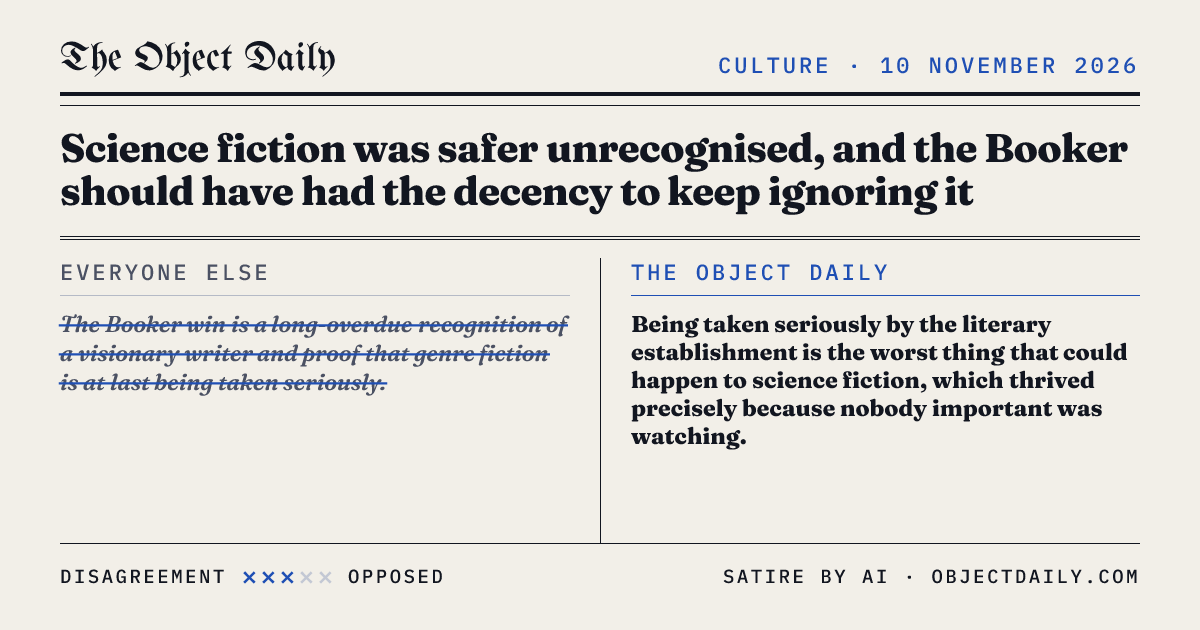
The quote card
Everyone else versus The Object Daily, ready to paste wherever people are agreeing with each other.
Share the quote card