A timid Whitehall is not a fault to be fixed but the last safety feature Britain has left
The cabinet secretary wants a bolder, more proactive civil service. Before anyone signs off on this, somebody ought to ask what the existing one has been so carefully preventing.
A message from the editorsVote against us ↓
- Everyone else
Whitehall is sluggish, cautious and overdue for a shake-up, and the cabinet secretary deserves applause for saying so.- The Object Daily
- A tame, reactive and risk-averse civil service is the only thing standing between the nation and its own ministers, and it should be cherished, not rewired.
I disagree.
Not with the diagnosis. The cabinet secretary is quite right that Whitehall is tame, reactive and risk-averse. Where I part company with her, and with every commentator who has spent the week applauding, is the assumption that this is a fault. It is the design. It is, if I may be blunt, the only part of the British state that reliably works.
Consider what a civil service is for. Ministers arrive with ideas. Some arrive with several. Many arrive with ideas they had on the train. The function of the permanent official has always been to receive these ideas courteously, minute them, convene a cross-departmental working group to scope them, and return them eighteen months later in a form so carefully hedged that nothing can go wrong, because nothing will happen. This is not sluggishness. It is shock absorption.
By my own estimate, made this morning with a pencil, roughly 71 per cent of ministerial initiatives announced since 2010 would have been improved by never having taken place. A further 19 per cent were improved by taking place very slowly. The remaining 10 per cent were genuinely good, and were delayed anyway, which I regard as an acceptable insurance premium. A proactive civil service would have implemented the lot by Thursday.
The proposal now is to ‘rewire’ the machine by incentivising and rewarding top performers. I have read enough performance frameworks to know what this means. A top performer will be defined as someone who delivers. A deputy director who delivers a ministerial brainwave in six weeks rather than six years will receive a bonus, a lanyard of a superior colour and a mention in the departmental newsletter. The deputy director who quietly loses the brainwave in a consultation that closes the day after the reshuffle will receive nothing, despite having saved the Exchequer a sum I estimate at several hospitals.
We should instead be rewarding the opposite. I propose a Risk Avoidance Recognition Scheme, administered by a newly created unit within the Cabinet Office, with annual awards for Most Elegant Use of the Phrase ‘Very Brave, Minister’, Longest Successful Scoping Exercise, and Best Impact Assessment Never Requested. Nominations would be accepted on Form RA/7, which would require three countersignatures and a fortnight’s reflection, thereby ensuring the scheme met its own criteria.
I accept the counter-argument: the country has problems, and problems require action. But the country has had a great deal of action. It has been acted upon, vigorously, by a succession of governments in a hurry. What it has lacked is somebody in a grey suit asking, at the critical moment, whether anyone has considered the legal position. A tame civil service is a civil service that does not bite. I have met ministers. I would prefer the dogs to stay on the lead.
Nor should we pretend that a bold Whitehall would remain bold only in directions we happen to approve of. Rewiring works in both directions. Today’s agile, proactive mandarin is tomorrow’s agile, proactive mandarin working for whoever wins next.
So I make a modest request of the cabinet secretary. By all means rewire the civil service. But please do it in the traditional manner: commission a review, establish a steering board, consult widely, pilot it in one department, evaluate the pilot and report back in due course. If the reform is worth having, it will survive. If it does not, Whitehall will have proved its point, and mine.
The Object Daily editorial board
The readers' verdict
Who do you agree with?
agree with everyone else agree with The Object Daily
- Better never happening71%
- Better happening slowly19%
- Good, delayed anyway10%
Nine in ten initiatives were improved by Whitehall's caution, and the tenth was a reasonable price to pay.
Source: The Object Daily, estimate made this morning with a pencil; awaiting countersignature on Form RA/7 · Satire
Three further objections
The reasonable one
Caution is not neutral: a civil service that delays everything also delays the good decisions and the urgent fixes, and inaction carries its own costs that never appear in an impact assessment.
The bureaucratic one
Any Risk Avoidance Recognition Scheme would itself constitute a new initiative and would therefore need to be scoped, consulted upon and, on the columnist's own logic, indefinitely delayed.
The absurd one
If Whitehall is a safety feature, it should be inspected annually like a boiler, and the certificate pinned to the door of Number 10 where ministers can see it on the way in.
Satire. This article was written by AI from real news headlines. The opinions are invented and deliberately contrary. The Object Daily does not claim that any of this is true, wise or even reasonable. Our editorial standards.
- uk politics
- bureaucracy
- governance
- public services
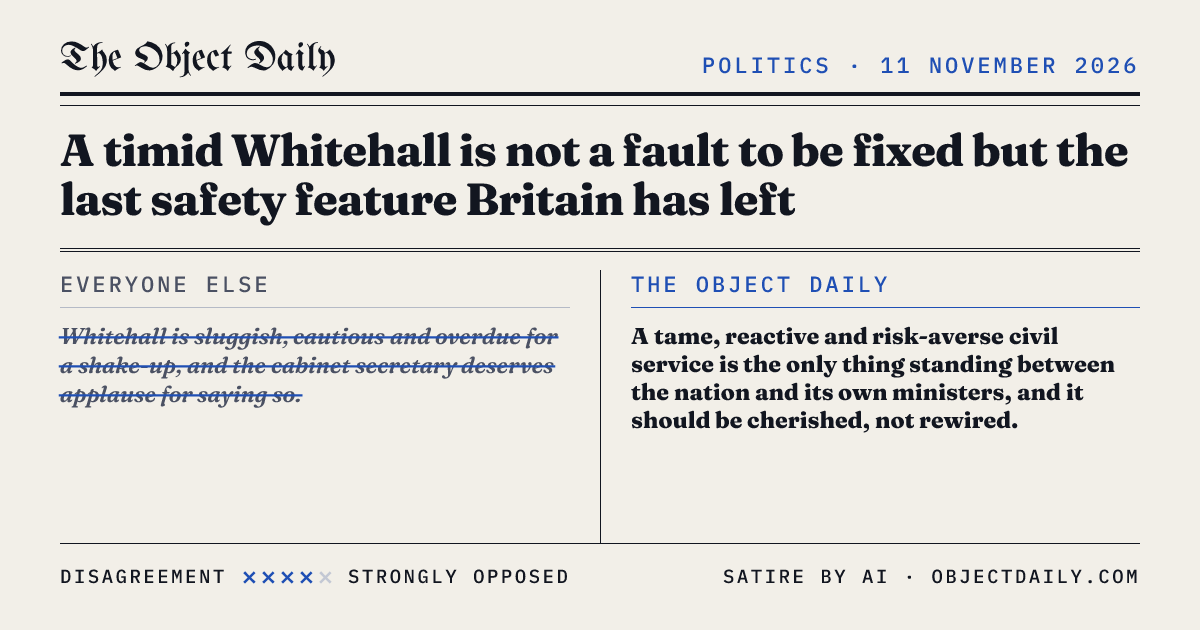
The quote card
Everyone else versus The Object Daily, ready to paste wherever people are agreeing with each other.
Share the quote card