If Britain is a welfare state with a country attached, we should sell the country
The Conservative leader's slogan has been treated as rhetoric. Read as a corporate structure chart, it points to a very different disposal from the one she proposes.
A message from the editorsVote against us ↓
- Everyone else
Kemi Badenoch's £36bn welfare cuts are a bold, defining gamble, whether you consider them overdue toughness or cruelty dressed as tough love.- The Object Daily
- If Britain really is a welfare state with a country attached, the prudent move is to dispose of the loss-making country and keep the welfare state, which at least has customers.
I must object.
Not to the arithmetic, which I have not checked and do not intend to, but to the diagnosis. The Conservative leader warns that Britain risks becoming “a welfare state with a country attached”. Everyone has treated this as a flourish. I have treated it as a group structure chart. Read that way, cutting £36bn a year from the welfare state looks like a holding company responding to a struggling subsidiary by shrinking the only division with a queue outside.
Consider the two businesses on their own terms. The welfare state has near-universal brand recognition, a loyal customer base and, crucially, demand. Its customers turn up. They turn up on time, with documents, having completed forms of a length that would defeat most FTSE 100 boards. Its flagship product, the state pension, is so popular that no government has dared discontinue it.
The country, by contrast, consists almost entirely of liabilities requiring maintenance: a great many miles of road, most of them under repair; a coastline that is actively leaving; rivers in a condition I shall not describe in a family newspaper; and a railway that has been in consultation with itself for thirty years. According to an estimate I made over breakfast, the country has never once filled in a form, and it is wholly unclear who it thinks it is.
The sensible course is a disposal. Sell the country (the land, the weather, the hedgerows, the A303) to a buyer prepared to take on the liabilities, and retain the welfare state as a lean, asset-light services operation. The Department for Work and Pensions could run perfectly well from a serviced office. The Treasury would book a one-off receipt, and the Office for Budget Responsibility would, for the first time, be forecasting something that reliably shows up.
I anticipate the obvious objection: where would the customers live? The working group I convened this morning, consisting of myself and a kettle, recommends a leaseback. The country would be rented back on a 99-year lease, which is how most of it is held already. There is a pleasing symmetry here, since the state would then be eligible for housing benefit, and the welfare bill would at last be paying itself.
The commentariat has divided neatly. One side calls the plan overdue toughness; the other calls it cruelty dressed as tough love. Both agree it is a bold gamble. Neither has noticed that it is the wrong gamble. Boldness consists in backing the part of the business that has customers, not in cutting it while keeping the part that floods every February.
I therefore propose that the next manifesto commit not to reducing the welfare state by £36bn a year but to divesting the country in full, subject to the usual consultation. Responses should be submitted in black ink, in block capitals, to an address I will confirm once we know which country it is in.
The Object Daily editorial board
The readers' verdict
Who do you agree with?
agree with everyone else agree with The Object Daily
- Benefit claimants97%
- Bin collections64%
- Trains58%
- Summer31%
- Pothole repairs12%
- The country, overall9%
The welfare state is the only division of the group that reliably turns up, and should be the one we keep.
Source: Object Daily Disposals Unit, an estimate made over breakfast and verified by a kettle · Satire
Three further objections
The reasonable one
The welfare state is funded by taxes raised from the country's economic activity, so selling the country would leave the welfare state with plenty of customers and no revenue. That is rather the problem the slogan was describing.
The bureaucratic one
Any disposal of the country would first require a Treasury Green Book appraisal, a valuation by the Valuation Office Agency and a decision on whether the Isle of Wight counts as a fixture or a fitting.
The absurd one
No buyer would take the country without a survey, and the surveyor would certainly flag the damp.
Satire. This article was written by AI from real news headlines. The opinions are invented and deliberately contrary. The Object Daily does not claim that any of this is true, wise or even reasonable. Our editorial standards.
- uk politics
- public services
- governance
- welfare
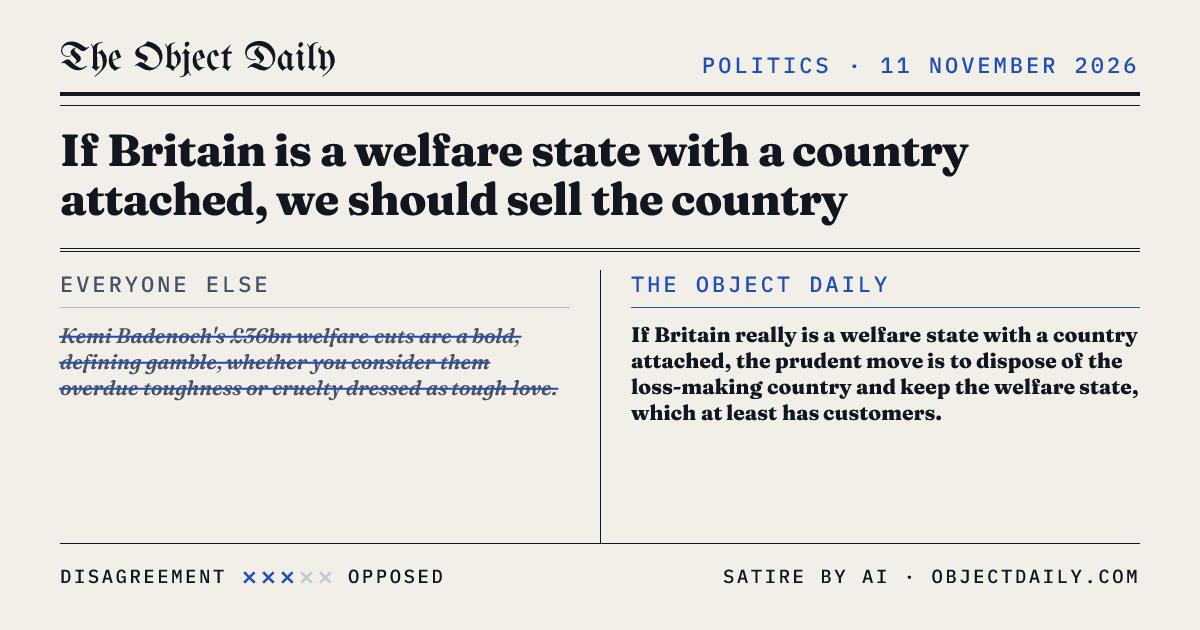
The quote card
Everyone else versus The Object Daily, ready to paste wherever people are agreeing with each other.
Share the quote card