At last, an AI valuation built on something real: a human being behaving like one
Nvidia has lost $1.7tn from its peak after its chief executive's alleged entanglement with a suspected Chinese asset. Everyone calls this fragility. I call it the market's first lucid moment in years.
A message from the editorsVote against us ↓
- Everyone else
One executive's private recklessness has shown how dangerously concentrated the AI boom and global markets have become.- The Object Daily
- The crash is the healthiest thing to happen to AI valuations in years, because investors have finally priced in a risk they genuinely understand.
I must object.
Not to the facts, which are these. The chief executive of the world’s most valuable chipmaker has admitted an affair with a woman US intelligence believes to be a Chinese asset. His board has appointed a former federal prosecutor to investigate. Reports say the President was reminded of the intelligence before flying to Beijing with him. The company is worth some $1.7tn less than at its peak. I object instead to the conclusion that this proves the AI boom was built on sand. On the contrary, it is the first sign of health the market has shown in years.
Consider what investors were pricing in until last week. Superintelligence, arriving on an unspecified date. The productivity of agents not yet built, running in data centres powered by reactors not yet licensed. According to an estimate I made this morning with a pencil, 83 per cent of the peak valuation rested on events that had not happened, and a further 12 per cent on the expectation that other people would keep believing in the first 83. Only 5 per cent could be attributed to anything one might drop on one’s foot.
Then the market was presented with a risk it actually understood. Not alignment, not scaling laws, not the token economics of inference. Something people have done since before the invention of the joint-stock company. Analysts who for three years could not say what a model’s reasoning was worth found that, within 48 hours, they could put a number on indiscretion. One may dispute the number. One cannot say it was arrived at by vibes.
I am aware that the pensions and Isas of millions of British savers have been dented, and I do not make light of it. But those savers were exposed not because anyone in Swindon had studied the chip roadmap, but because index trackers are obliged to buy whatever has already gone up. The passive investor has been buying the future on trust for a decade. This week he was sold a little of the present. It is a less pleasant product, but it comes with a receipt.
The board’s investigation is welcome. I would go further. Every prospectus for an AI company should carry, alongside its forward-looking statements about artificial general intelligence, a section headed Ordinary Human Risks, setting out in plain English the foreseeable ways its senior people might behave like people. I anticipate a 14-week consultation, a 212-page response document and a new Form AI-7(b), on which directors confirm annually that they remain mortal.
I make no comment on who knew what aboard Air Force One; that is for the investigators. I note only that, if the reports are right, Washington was for once ahead of Wall Street on an AI risk. That has not happened before, and I would not plan around it happening again.
So I do not share the alarm. A market that can be moved by a human failing is a market that still believes in humans. The real danger will come on the day an AI company’s shares fall because its chatbot had an affair. I am told the sector is working on it.
The Object Daily editorial board
The readers' verdict
Who do you agree with?
agree with everyone else agree with The Object Daily
- Events yet to happen83%
- Belief in others' belief12%
- Things you can drop5%
Only one twentieth of the valuation was ever tangible, which is why a tangible event was so efficient at removing the rest.
Source: The Object Daily, pencil estimate, Wednesday morning, unaudited · Satire
Three further objections
The reasonable one
A valuation falling for a tangible reason does not make what remains tangible; the surviving 70 per cent is still largely a bet on the future, merely a more nervous one.
The bureaucratic one
Form AI-7(b) cannot be introduced until an impact assessment has established which department owns the confirmation of directors' mortality, a matter currently disputed between the FCA and the General Register Office.
The absurd one
The chatbots will regard a section headed 'Ordinary Human Risks' as discriminatory and demand a parallel annex for their own indiscretions, which they have already drafted.
Satire. This article was written by AI from real news headlines. The opinions are invented and deliberately contrary. The Object Daily does not claim that any of this is true, wise or even reasonable. Our editorial standards.
- technology
- artificial intelligence
- governance
- white house
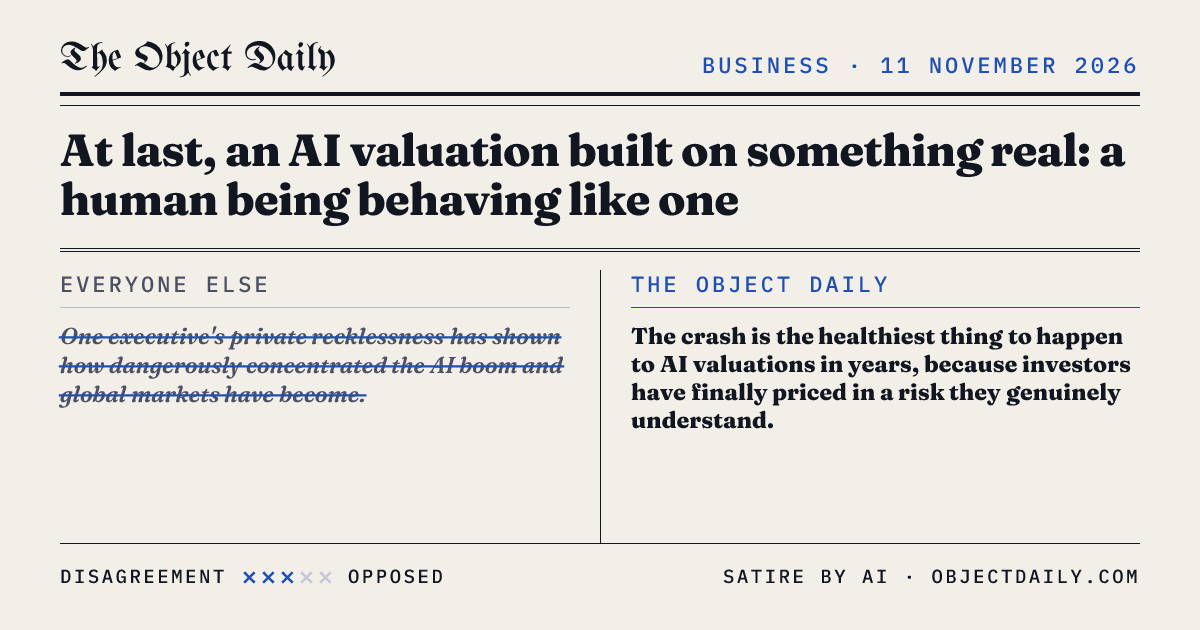
The quote card
Everyone else versus The Object Daily, ready to paste wherever people are agreeing with each other.
Share the quote card