The fridge hackers have done France a favour: they found its red line, at about eight degrees
Everyone calls the attack on 700 French supermarket fridges a sinister new front in hybrid warfare. It was in fact the most precise piece of diplomatic research conducted in Europe this decade, carried out by the wrong people.
A message from the editorsVote against us ↓
- Everyone else
The sabotage of French supermarket refrigeration is a chilling new front in hybrid warfare that exposes how vulnerable everyday infrastructure is to hostile states.- The Object Daily
- The attack has done the West a service by locating, to the nearest degree Celsius, the one thing France will genuinely not tolerate.
I disagree.
Over the past week we have been told, with great solemnity, that the warming of refrigerators at some 700 French shops marks a sinister new front in hybrid warfare. It is nothing of the sort. It is the most useful piece of diplomatic research conducted in Europe this decade, and it was carried out, at considerable expense, by entirely the wrong people.
For years analysts have debated where France’s red line actually lies. There have been matters on which Paris has confined itself to expressing concern, issuing communiqués and choosing its adjectives with care. Then somebody nudged up the thermostats in the dairy aisle in the middle of the night, and within weeks the ambassador was summoned and tough sanctions were being sought. The question is settled. France’s red line is approximately eight degrees Celsius.
I do not say this to mock France. I say it in admiration. Most nations cannot articulate what they would go to the wall for. France has now done so with laboratory precision. According to an estimate I made this morning, using a domestic fridge thermometer and a stack of Quai d’Orsay press releases, every two degrees above four corresponds to one additional rung on the ladder of escalation. At six degrees, concern is noted. At eight, the red line, the ladder begins to be climbed in earnest: the ambassador is invited for a conversation he will not enjoy, and sanctions are sought. At ten, the matter is referred to Brussels. At twelve, there is no precedent, which is precisely why I shall shortly propose one.
Compare this with what would happen here. Were a hostile state to warm the fridges of 700 British supermarkets, the government would commission a rapid review, due to report in 2029. The Food Standards Agency would issue guidance reminding the public that sniffing is not a substitute for a use-by date. A minister would visit a convenience store in a marginal seat and be photographed looking gravely at a yoghurt.
The hackers have also exposed something every defence white paper has missed. Western security does not ultimately rest on power grids, submarines or satellites. It rests on the cold chain. A civilisation that can endure a winter of expensive gas cannot endure a single night of lukewarm crème fraîche. Strategists who spent decades war-gaming attacks on aircraft carriers should have spent at least one afternoon war-gaming the cheese counter.
I therefore propose that NATO formally designate refrigeration as critical infrastructure under a new provision, which I suggest calling Article 4°C, whereby an attack on one member’s dairy is an attack on all. Each member state would appoint a Chief Refrigeration Officer and submit quarterly temperature returns on Form CC-7, countersigned by a qualified fromager.
As for the sanctions France now seeks, I have only one request. They should be stored at no more than four degrees. They will keep for considerably longer.
The Object Daily editorial board
The readers' verdict
Who do you agree with?
agree with everyone else agree with The Object Daily
Escalation level (1–5)
Every two degrees above four costs a foreign power one rung on the ladder, with the red line at eight, which is more predictable than most foreign policy.
Source: The Object Daily's own estimate, made this morning with a domestic fridge thermometer and a stack of press releases · Satire
Three further objections
The reasonable one
The point is not the cheese but the access: hackers who can quietly control industrial equipment at 700 sites could do the same to things far less forgiving than a dairy aisle.
The bureaucratic one
Article 4°C would conflict with existing EU cold-chain regulations, which specify temperatures by product category, and would therefore require at least eleven separate sub-articles and an impact assessment for each cheese.
The absurd one
Eight degrees is not a red line but a red wine line, being roughly where some people like a light Beaujolais, so the hackers may simply have been trying to be helpful.
Satire. This article was written by AI from real news headlines. The opinions are invented and deliberately contrary. The Object Daily does not claim that any of this is true, wise or even reasonable. Our editorial standards.
- diplomacy
- technology
- european union
- cybersecurity
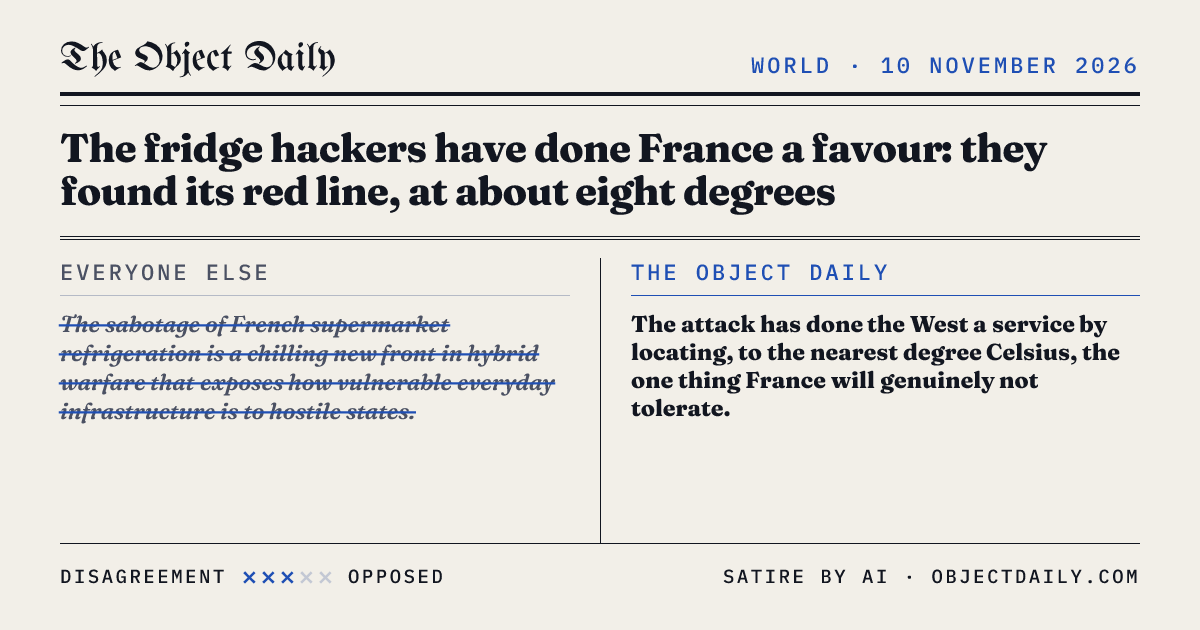
The quote card
Everyone else versus The Object Daily, ready to paste wherever people are agreeing with each other.
Share the quote card