A weaker electric car target is the greenest policy this government has produced
The zero-emission mandate is expected to be cut this week, to howls from both sides. Both have missed that a target emits nothing, costs nothing and can be revised downwards forever without harming a single hedgerow.
A message from the editorsVote against us ↓
- Everyone else
Cutting the electric vehicle sales targets is either a betrayal driven by carmaker lobbying or long-overdue realism.- The Object Daily
- A target is Britain's only truly zero-emission technology, and lowering it simply returns it to its natural, pristine state of aspiration.
I disagree.
Not with the environmentalists, who call this week’s expected cut to the zero-emission vehicle mandate a betrayal. Nor with the motor industry, which calls it realism. I disagree with both, because both have assumed that a target is meant to be met. It never has been. A target is, by some distance, the cleanest thing a government can produce.
Consider the inputs. An electric car requires lithium, cobalt, a factory and a roadside charging point that works on alternate Tuesdays. A target requires a press release and, in more ambitious departments, a launch event with orange juice. According to an estimate I made this morning on the back of a consultation response, the average Whitehall target has a lifetime carbon footprint of 0.4 kilograms, most of it attributable to the lanyard.
Better still, a target emits nothing while in service. It does not idle at traffic lights. It does not require a second vehicle for the school run. It sits in an annex, perfectly inert, for years at a time, and it can be revised downwards at no environmental cost whatsoever. I am aware of no other technology with this property. Hydrogen cannot do it. Nuclear certainly cannot.
Critics will say the mandate is supposed to cause things: no new petrol or diesel cars by 2030, nothing but zero-emission cars by 2035. This confuses a target with a plan, a mistake no experienced civil servant would make. A plan has actions, owners and a risk register. A target has a date, chosen precisely because it falls after the next spending review but before anyone currently in post can be held responsible. Cutting it does not abandon the target. It returns the target to its natural state, which is aspiration.
Indeed, the most sustainable targets in British history are those that were never reached, because they can be recycled indefinitely. A target missed in 2030 may be restated for 2035, then for 2040, then reannounced as a ‘renewed commitment’, each time without consuming a single new raw material. This is the circular economy the Treasury has always wanted: one that circulates entirely within itself.
Labour MPs who are protesting should also reflect that a high target is itself an emissions risk. It creates pressure. Pressure creates activity. Activity, as any physicist will confirm, uses energy. A lower target reduces activity and therefore, by a chain of reasoning I have set out in a fourteen-page annex, reduces emissions. The greenest possible target would be zero, set for a date that does not exist and overseen by a working group that never meets. I have already drafted its terms of reference.
I therefore welcome the cut, but I urge ministers not to stop there. Rather than weakening the mandate this week, they should announce their intention to consult on weakening it, followed in due course by a review of the consultation. That would keep the target in a state of untouched, unexploited aspiration for a further eighteen months. It is, I accept, slightly less green than doing nothing at all. But doing nothing at all has never been popular with ministers, and we must meet them where they are.
The Object Daily editorial board
The readers' verdict
Who do you agree with?
agree with everyone else agree with The Object Daily
Kilograms CO2e
- New petrol car45,000
- New electric car22,000
- Ambitious target0.4
- Weakened target0.3
- Consultation on target1.2
Measured per tonne of ambition, nothing on the road comes close to a target that has been sensibly lowered.
Source: The Object Daily estimate, compiled this morning on the back of a consultation response; lanyard emissions allocated pro rata · Satire
Three further objections
The reasonable one
A target that can be lowered whenever it becomes inconvenient stops guiding anyone's investment decisions, so its emissions are merely displaced onto the cars that keep being sold in the meantime.
The bureaucratic one
Any revision to the mandate must first be logged against the original target's baseline assumptions, which were archived in a format the department no longer supports and cannot open without a separate procurement exercise.
The absurd one
If targets are truly zero-emission, the government should set targets for the targets, thereby creating a negative-emission system that could in principle refreeze a modest glacier by 2035.
Satire. This article was written by AI from real news headlines. The opinions are invented and deliberately contrary. The Object Daily does not claim that any of this is true, wise or even reasonable. Our editorial standards.
- uk politics
- governance
- bureaucracy
- electric vehicles
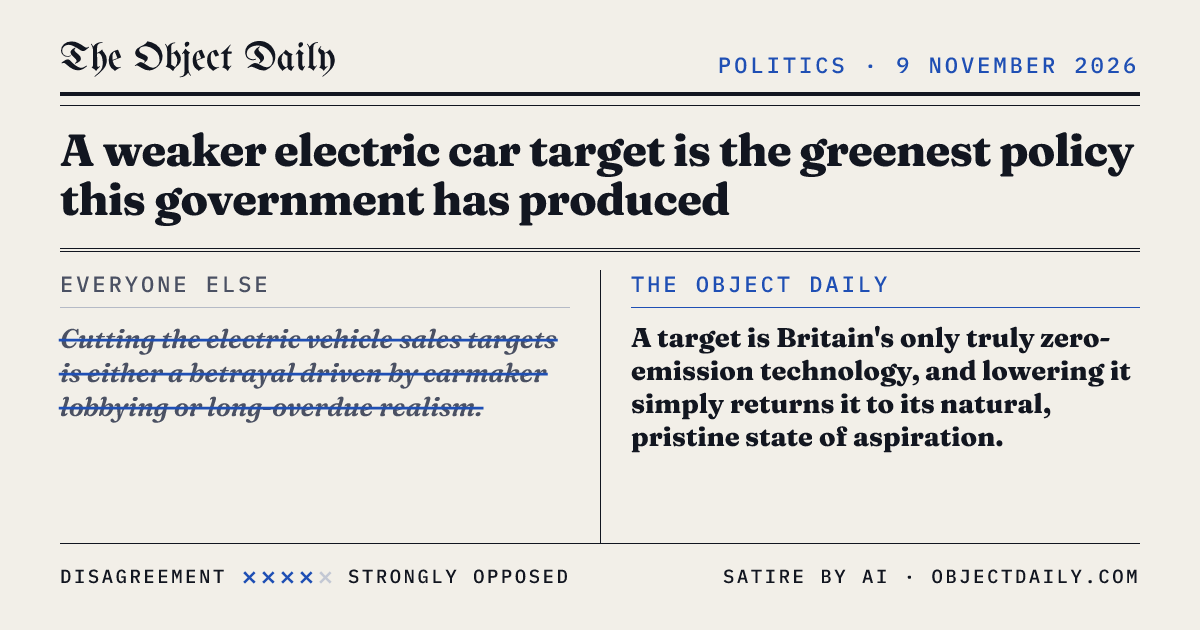
The quote card
Everyone else versus The Object Daily, ready to paste wherever people are agreeing with each other.
Share the quote card