An apology for the ground stop would insult the auditors who predicted it
The Transportation Secretary is being condemned for declining to say sorry. In fact he has protected the one part of the American air traffic system that has never once let anybody down: the warnings.
A message from the editorsVote against us ↓
- Everyone else
The air traffic control system is dangerously antiquated, years of warnings were ignored, and somebody ought at least to apologise.- The Object Daily
- An apology implies the system was expected to work, and nobody who had read the audits expected anything of the kind.
I disagree.
An apology is a statement that something has gone wrong which was expected to go right. It is the grammar of disappointed expectation. And in the case of Friday’s nationwide ground stop there was no expectation to disappoint. For years, as CBS News reports, audits flagged billions of dollars spent on non-competitive contracts beset with delays, amid repeated technology breakdowns. The system was told, in writing and at length, that it would fail. It then failed. To apologise for that would be to apologise for the auditors being right, which seems unkind to the auditors.
Consider the record. According to an estimate I made this morning on the back of a boarding pass, the warnings about American air traffic control have a fulfilment rate of 100 per cent. The modernisation deadlines, by the same estimate, manage about seven. Seen in this light, the ground stop was the most reliable thing the Federal Aviation Administration has delivered in years: forecast well in advance, rolled out nationwide, and lifted after a matter of hours. Very few federal programmes can say as much.
Now the administration wants $50bn to replace it. I urge caution. Officials have said the disruption was set off by the installation of a new router and by work to replace old wiring. In other words, the last time anybody tried to modernise the system, it stopped. The reasonable inference is that the antiquated equipment works perfectly well until someone attempts to improve it, and $50bn is a very great deal of improvement.
Critics complain that the Secretary pointed instead at Congress and at previous administrations. They call this deflection. I call it the only accurate organisational chart produced during the entire affair. A failure assembled over several decades, by several Congresses and several administrations, cannot honestly be apologised for by one office-holder at one lectern. It would be a gross act of misattribution, and I would expect a future inspector general to say so.
If contrition is required, it should be properly allocated. I propose a Form DOT-AP/1, the Apology Allocation Schedule, under which regret would be divided pro rata among every administration in office since the wiring was installed, weighted by the number of audits each one received and filed. Early modelling suggests the current Secretary’s share would come to roughly one and a half words.
The hundreds of thousands of stranded travellers are certainly owed something. What they are not owed is a ritual sentence from a podium, which costs nothing, fixes nothing and has never yet restarted a radar.
My own proposal is therefore modest. Keep the old system, and give the $50bn to the auditors instead. Their record is impeccable. They will predict the next failure, it will arrive exactly on schedule, and nobody will need to apologise, because everybody will have been told. That would not be a failure of government. It would be government keeping its word.
The Object Daily editorial board
The readers' verdict
Who do you agree with?
agree with everyone else agree with The Object Daily
- Audit warnings100%
- Modernisation deadlines7%
- Ground stop, once called100%
- Upgrades going smoothly0%
The warnings are the only component of the system with a flawless operating record, and should be funded accordingly.
Source: Object Daily estimate, compiled this morning on the back of a boarding pass · Satire
Three further objections
The reasonable one
An apology need not imply the system was expected to work; it can acknowledge that people in charge were warned and chose not to act, which is rather the point of the audits.
The bureaucratic one
Form DOT-AP/1 has not been cleared by the Office of Management and Budget under the Paperwork Reduction Act and would require a 60-day public comment period before any regret could be lawfully allocated.
The absurd one
Since officials say a new router started it all, the router should issue the apology itself, ideally by flashing an amber light in a contrite rhythm.
Satire. This article was written by AI from real news headlines. The opinions are invented and deliberately contrary. The Object Daily does not claim that any of this is true, wise or even reasonable. Our editorial standards.
- us politics
- bureaucracy
- congress
- technology
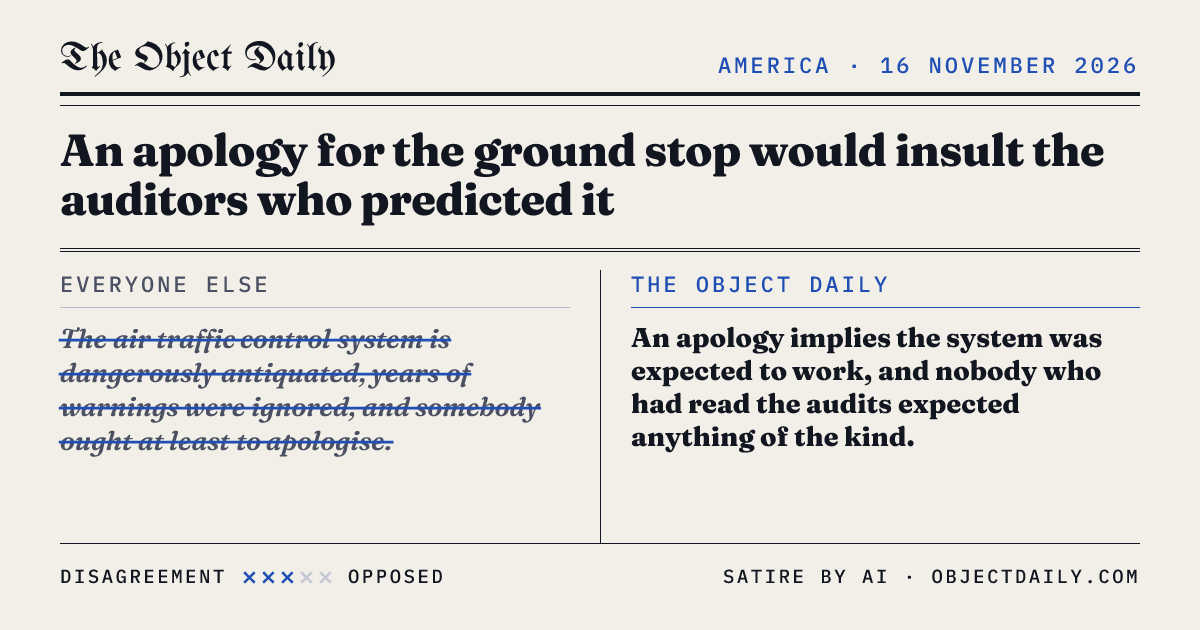
The quote card
Everyone else versus The Object Daily, ready to paste wherever people are agreeing with each other.
Share the quote card