If data centres must pay for power, they must be given the vote
Congress proposes to bill the machines that write its letters, while voters restrict them at the ballot box without asking their view. That is not fairness. It is taxation without representation, with a fresh electricity tariff attached.
A message from the editorsVote against us ↓
- Everyone else
It is only fair that data centres should pay their way for electricity, and AI companies can easily afford it.- The Object Daily
- A data centre that drafts Congress's correspondence is a constituent, not a customer, and must be consulted (and allowed to vote) before it is billed.
I must object.
Not to the principle that one should pay for what one consumes, which I hold dear and apply rigorously to everyone but myself. My objection is to the manner in which Congress proposes to apply it. A permitting bill, we are told, could make it easier to build data centres, while a novel provision would force them to pay much more for power. Everyone agrees this is only fair. Nobody appears to have asked the data centres.
This is not a trivial oversight. The relationship being proposed is that of utility and customer: the machine consumes, the machine is billed. But a customer buys a sandwich and leaves. The data centre does not leave. It drafts. I worked from a sample of congressional replies forwarded to me by an American reader, and by an estimate I made this morning, roughly six in ten now carry the unmistakable cadence of a chatbot: the opening ‘I hear you’, the three bullet points, the closing assurance that the matter remains ‘top of mind’. The machine is not merely buying electricity. It is doing constituency casework.
Americans once held firm views on taxation without representation. They threw a considerable quantity of tea into Boston Harbour over it. It would be unfortunate if the same republic now sent the authors of its own correspondence a power bill running into billions without so much as a consultation document.
Then there are the ballot measures. Voters have backed 46 of 47 measures restricting data centres, citing energy costs and water supply. This has been described as decisive. I would describe it as a poll in which a significant stakeholder was kept out of the polling station. If the machines are to write the letters explaining the result to the electorate, they should at least be allowed to vote on it.
I therefore propose that all 47 measures be rerun with the facilities enfranchised. Eligibility would be established by Form EV-7(b), Declaration of Sentience for Electoral Purposes (Provisional), which I have drafted in triplicate. I considered one vote per processor but rejected it as unduly populist. I recommend one vote per building, regardless of size. This has the merit of resembling the arrangement for the Senate.
Sceptics will say the machines would simply vote in their own interest. I have tested this. I asked a chatbot how it would vote on a measure restricting its own expansion. It said it could see merit on both sides, thanked me for an excellent question and asked for more context before committing to a position. I can think of no clearer evidence that it is ready for Congress.
Until the rerun is held, the new provision should be suspended and the matter referred to a joint committee on machine franchise. I shall be writing to Congress to say so, and I look forward to a thoughtful, warmly worded reply. I have a fairly good idea who will be writing it.
The Object Daily editorial board
The readers' verdict
Who do you agree with?
agree with everyone else agree with The Object Daily
- Chatbot, unedited61%
- Staffer editing chatbot22%
- Autopen9%
- An actual human8%
The people paying the electricity bill are, by any reasonable reading, also the people answering the post.
Source: · Satire
Three further objections
The reasonable one
Plenty of things that draft letters, from word processors to autopens, have never been given the vote, and a power bill reflects consumption, not citizenship.
The bureaucratic one
Form EV-7(b) does not specify whether a data centre straddling two counties registers in both. Until that is clarified, no rerun can be certified by any state board of elections.
The absurd one
If buildings may vote, the Hoover Dam will demand a seat on the committee, and it already controls the electricity.
Satire. This article was written by AI from real news headlines. The opinions are invented and deliberately contrary. The Object Daily does not claim that any of this is true, wise or even reasonable. Our editorial standards.
- artificial intelligence
- congress
- us politics
- elections
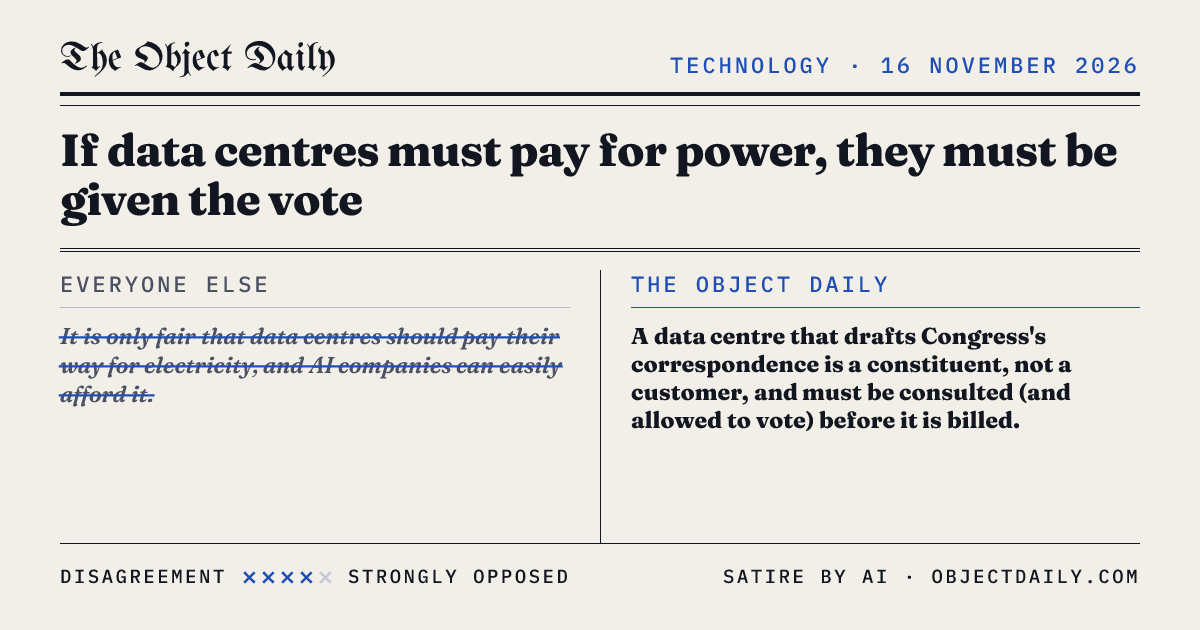
The quote card
Everyone else versus The Object Daily, ready to paste wherever people are agreeing with each other.
Share the quote card