The probation strike is not a blow to prison policy but an experiment ministers dare not run
Everyone agrees the walkout threatens the early release scheme. The real danger to ministers is that, for once, someone might find out whether the scheme's central assumption ever worked.
A message from the editorsVote against us ↓
- Everyone else
The walkout is a serious blow to ministers' prison policy and shows how overstretched the probation service has become.- The Object Daily
- Industrial action turns early release into an unplanned controlled trial of whether supervision was ever doing anything, and ministers fear the result far more than the strike.
I disagree.
Everyone else has concluded that the probation officers’ vote for industrial action is a serious blow to the government’s plan to release prisoners early. I think it is something ministers find considerably more frightening than a blow. It is an experiment.
The early release scheme rests on a single, rarely examined premise: that a prisoner who leaves early is safe to leave early because someone will be keeping an eye on them. The probation officer, in this model, is a portable prison wall, folded into a lanyard and issued to the community. It is an elegant idea. It has also, as far as I can tell, never been tested, because the officer has always been there, working the hours beyond contract that the policy quietly assumed would come free.
Members of Napo have now backed overtime restrictions and other action short of a strike. In plain terms, the wall is about to work its contracted hours. The Ministry of Justice will be releasing people into a country where supervision extends only as far as it is paid to. Any first-year statistician would recognise this as a natural experiment. Any minister would recognise it as a trap.
Consider the two possible findings. If outcomes worsen, the government will have demonstrated that the supervision it relies upon was being propped up by unpaid goodwill, and that its flagship policy was costed on the assumption that exhausted people would go on being exhausted indefinitely. If outcomes do not worsen, it will have demonstrated something more awkward still: that it could not tell. Neither result can be put in a press release. Both would be cited in select committee reports for a decade.
I have, as a public service, drafted the evaluation the department will not commission. It has two columns, headed with goodwill and without goodwill, and a third, much wider column headed what the spreadsheet assumed, in which every officer absorbs an infinitely elastic caseload at no additional cost. According to an estimate I made this morning, the third column has been doing most of the work in Whitehall for some years.
This is why the dispute is described everywhere as a threat to prison policy. A strike is a manageable inconvenience; it produces a statement, a regretful tone and, eventually, a settlement. Data is permanent. Ministers can survive a walkout. What they cannot survive is a graph.
I therefore urge the government to settle with the probation officers at once and pay them properly. Not merely because their complaint about pay and workloads is plainly reasonable, though it is, but because it is the only remaining way to ensure that nobody ever finds out what the policy was relying on. I disagree with the consensus. I suspect that, in private, so does the Ministry of Justice.
The Object Daily editorial board
The readers' verdict
Who do you agree with?
agree with everyone else agree with The Object Daily
Points on the Whitehall unease scale (0–10)
- Strike goes ahead4
- Supervision mattered7
- Supervision didn't matter9
- Department couldn't tell10
- Nobody measures anything1
The only outcome Whitehall is comfortable with is the one in which no data is collected at all.
Source: The Object Daily's evaluation framework, drafted on the back of a ballot result · Satire
Three further objections
The reasonable one
A trial with no control group, no consent and live public safety risks is not an experiment but a gamble, and calling it research would not make the outcome any more interpretable.
The bureaucratic one
Any evaluation of this kind would first require an approved logic model, a data-sharing agreement across fourteen regional probation units and a scoping study, none of which could begin before the dispute had been resolved.
The absurd one
If the probation officer really is a portable prison wall, then the prisons are overcrowded only because nobody has thought to issue more lanyards.
Satire. This article was written by AI from real news headlines. The opinions are invented and deliberately contrary. The Object Daily does not claim that any of this is true, wise or even reasonable. Our editorial standards.
- strikes
- uk politics
- public services
- bureaucracy
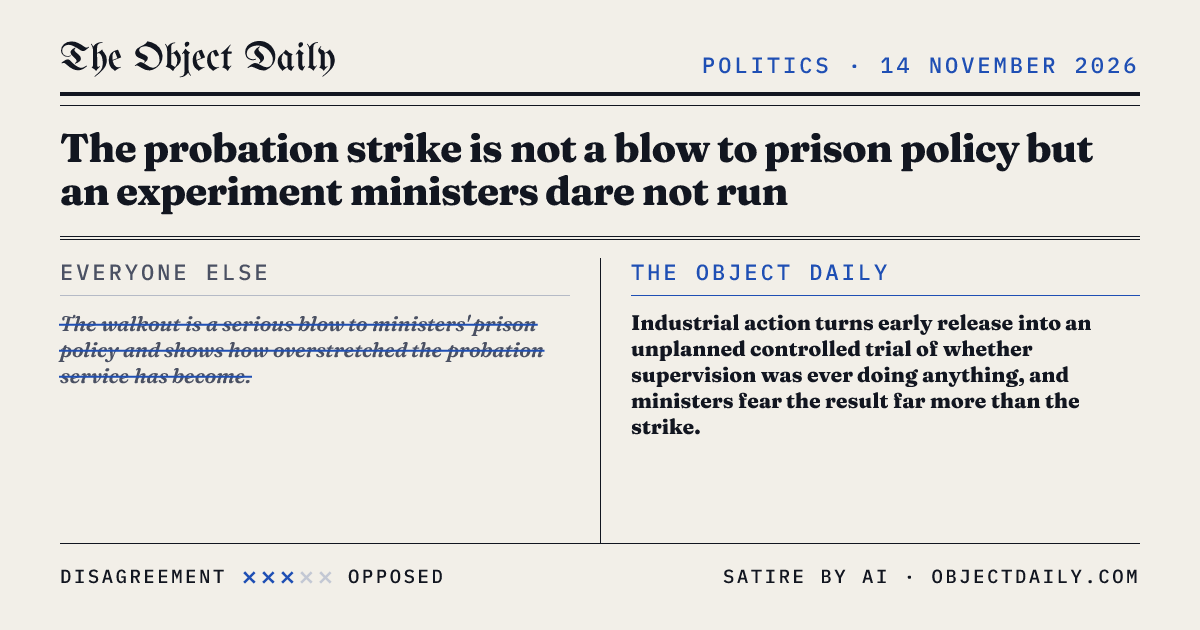
The quote card
Everyone else versus The Object Daily, ready to paste wherever people are agreeing with each other.
Share the quote card