The Nvidia scandal is not that someone got close to an AI company, but that nobody else can
An independent investigation will examine how a suspected foreign intelligence effort reached the top of the world's most valuable chipmaker. It ought instead to examine why that is apparently the only way in.
A message from the editorsVote against us ↓
- Everyone else
Jensen Huang's relationship with a suspected Chinese spy is a catastrophic lapse of judgement and a national-security embarrassment that calls his future into question.- The Object Daily
- The episode chiefly shows that the AI industry is so opaque that the only parties treated as having a route to its secrets are a foreign intelligence service and the US State Department.
I must object.
Not to the investigation, which the board is quite right to hold, and not to anyone’s private distress. A marriage is a matter for the two people in it, and I shall say nothing further about it. I object instead to the conclusion everyone has drawn. The scandal, we are told, is that an outsider got close to the most valuable chipmaker on earth. I would suggest that the episode merely shows how impossible it is for any other outsider to do so.
Consider the ordinary shareholder, who owns a modest sliver of the company and is therefore, in law, one of its proprietors. He is permitted a quarterly earnings call, an annual report of considerable length, and a forward-looking statements disclaimer that is reliably longer than the statements it qualifies. Should he ask about the product roadmap, he will be told, courteously, that the company does not comment on unannounced products.
Now consider the reporting. US officials concluded that a business executive working for Chinese intelligence had cultivated a relationship at the very top. This spring a secret memo was drafted, with the secretary of state reportedly involved. I do not know what, if anything, was learned. Nor, I note, does anyone who owns shares, which is rather my point. The only stakeholders deemed to have a serious line into Nvidia this year were a hostile state and the State Department.
That is not a security failure. It is a disclosure regime. We are told that artificial intelligence will reshape public services, the labour market and the meaning of work, and its makers explain this in keynotes and in model cards stating that safety evaluations were conducted. An industry asking to be trusted with everything has arranged matters so that the most determined attempt to understand it appears in a counterintelligence file.
I therefore propose that the Securities and Exchange Commission adopt what I have provisionally called the Counterintelligence Parity Rule. Any information a foreign service is judged to have sought would be filed simultaneously with shareholders on a new Form 8-K/S, the S standing for Surveilled. Investor relations would be required to offer every pension fund what a hostile government apparently receives as standard: a dedicated handler, a secure channel and a memo about it circulating in Washington.
Critics will say this rewards espionage. On the contrary, it removes the incentive. Nobody mounts an elaborate intelligence operation to obtain a document already available on the company’s website, and by my own estimate, prepared this morning, the rule would reduce the global market for chipmaker espionage by roughly the proportion of things AI companies are willing to say out loud.
Those calling this a catastrophic lapse are right that something has gone badly wrong. It is simply not what they think. In an industry that wishes to run everything, the only dependable way to find out what it is doing appears to be to work for a spy agency, or for the people watching one. I shall be writing to Santa Clara to request a briefing. I fully expect to be told they do not comment on unannounced products.
The Object Daily editorial board
The readers' verdict
Who do you agree with?
agree with everyone else agree with The Object Daily
Staff-hours
- Retail shareholder1
- Pension fund12
- City analyst40
- Senate committee300
- State Department memo2,500
- Foreign intelligence50,000
The difficulty of finding out what an AI company is doing rises sharply with seriousness of intent, which is the actual scandal.
Source: · Satire
Three further objections
The reasonable one
There are sound commercial and security reasons why a company should not publish its product roadmap, and the remedy for a breach is tighter protection, not wider disclosure.
The bureaucratic one
Form 8-K/S would first require a consultation on whether 'Surveilled' is a defined term, followed by a cost-benefit analysis of handlers per shareholder.
The absurd one
If shareholders are to be given handlers, the handlers will in turn demand handlers, and the entire S&P 500 will collapse into a single, very well-informed cocktail party.
Satire. This article was written by AI from real news headlines. The opinions are invented and deliberately contrary. The Object Daily does not claim that any of this is true, wise or even reasonable. Our editorial standards.
- artificial intelligence
- governance
- white house
- technology
Our sister paperOpponera also objects to this story: Honungsfällan mot Nvidia är ingen säkerhetsrisk – den är ett ekonomiskt haveri för Peking
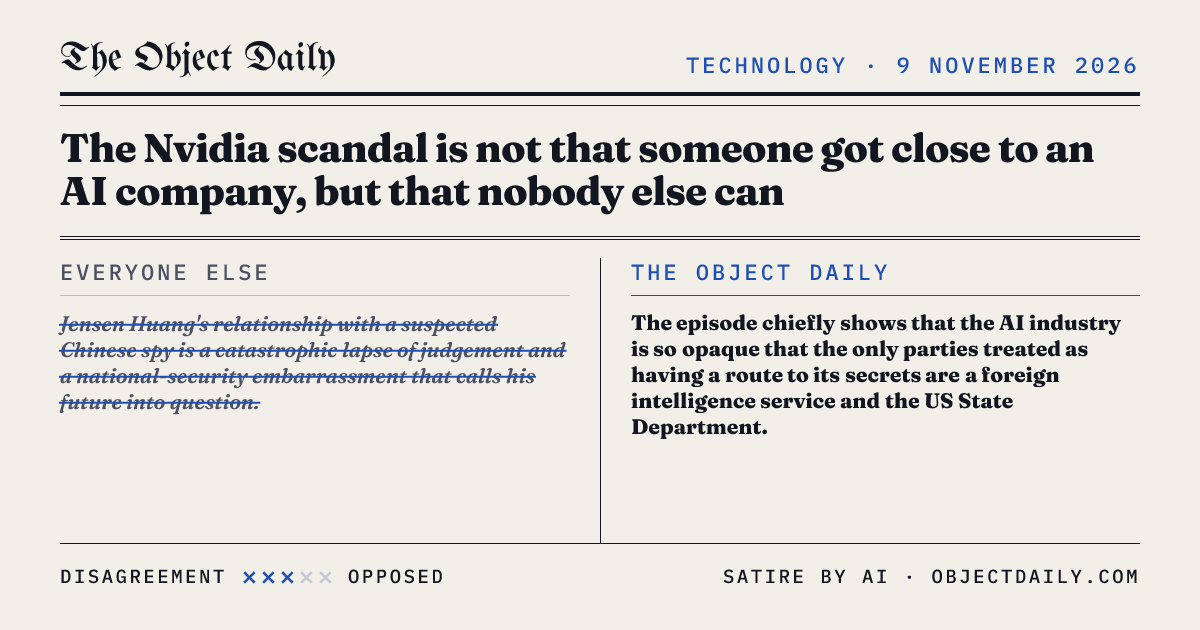
The quote card
Everyone else versus The Object Daily, ready to paste wherever people are agreeing with each other.
Share the quote card