Europe should have politely declined its seat at the table and kept its grievance instead
For years the continent's one settled foreign policy was that it ought to be in the room. Now that it has been invited in, it risks being asked what it actually thinks.
A message from the editorsVote against us ↓
- Everyone else
Europe's invitation to the Russia–Ukraine peace talks is a belated victory for European diplomacy.- The Object Daily
- By accepting the invitation, Europe has surrendered the only foreign policy position on which it has ever reliably agreed: that it was being left out.
I must object.
Not to peace, which is plainly desirable, nor to talks, which are usually how peace begins. I object to Europe accepting the invitation. For years the continent’s foreign policy has rested on one elegant principle, agreed in every capital without a single dissenting footnote: Europe ought to be in the room. It was the closest thing the continent possessed to a doctrine, and it has now been abolished by the simple expedient of being granted.
Consider what the position allowed. From outside the room one may express concern, reiterate concern, note with concern that earlier concern has not been addressed, and request a seat. According to an estimate I made this morning, roughly three-fifths of European diplomatic output in recent memory has consisted of that final item. It was cheap to produce, endlessly renewable and impossible to get wrong.
Inside the room, the questions change. Somebody across the table asks what Europe would accept, who would pay for it and how long it would last. These are not questions to which a joint communiqué is an answer. They require an opinion, held by an identifiable person, uttered aloud in front of witnesses who will remember it.
The administrative consequences are severe. A working group must now be convened to establish what Europe thinks, followed by a consultation on the working group’s terms of reference, followed by a drafting session on the wording of the consultation. Britain, having spent a decade establishing that it is simultaneously in and out of Europe, must now decide which door to use, and whether its chair counts towards the European allocation or is merely adjacent to it.
The correct response was a gracious refusal. Something along the lines of: We thank you for your kind invitation and regret that we must decline, as attendance would be incompatible with our long-standing policy of wishing to attend. The grievance would have survived intact, and could have been passed down, as all great European institutions are, to successor generations of officials.
Instead, we are told by the American envoy that no deal is possible without Europe. Taken at face value, this is the heaviest burden yet placed on the continent. Until now, any failure was somebody else’s. Europe has exchanged the luxury of blame for the far less comfortable condition of responsibility, and it appears to have done so voluntarily.
I therefore propose a compromise. Europe should attend, but insist on a smaller folding chair positioned slightly to one side, from which objections may still be lodged. Separately, a permanent Sub-Committee on Being Left Out should be established to preserve institutional memory of the old doctrine, in case it is ever needed again. I have written to request a seat on it. I fully expect to be refused, and I will be very disappointed if I am not.
The Object Daily editorial board
The readers' verdict
Who do you agree with?
agree with everyone else agree with The Object Daily
- Requests for a seat61%
- Expressions of concern22%
- Reiterated concern11%
- Actual proposals4%
- Catering queries2%
Europe has accepted an invitation that renders 61 per cent of its foreign policy redundant overnight.
Source: Object Daily estimate, compiled this morning from memory and a strong sense of grievance · Satire
Three further objections
The reasonable one
A grievance is only worth keeping if it achieves something, and complaining about exclusion from talks that will shape your own continent's security is a poor substitute for influencing them.
The bureaucratic one
Under the proposed arrangements a folding chair positioned slightly to one side would still need to appear on the seating plan, which would in turn require sign-off from the protocol unit, which does not meet until the new year.
The absurd one
Europe could simply attend in disguise, which would allow it to influence the outcome while officially maintaining that it was never there.
Satire. This article was written by AI from real news headlines. The opinions are invented and deliberately contrary. The Object Daily does not claim that any of this is true, wise or even reasonable. Our editorial standards.
- diplomacy
- european union
- bureaucracy
- us politics
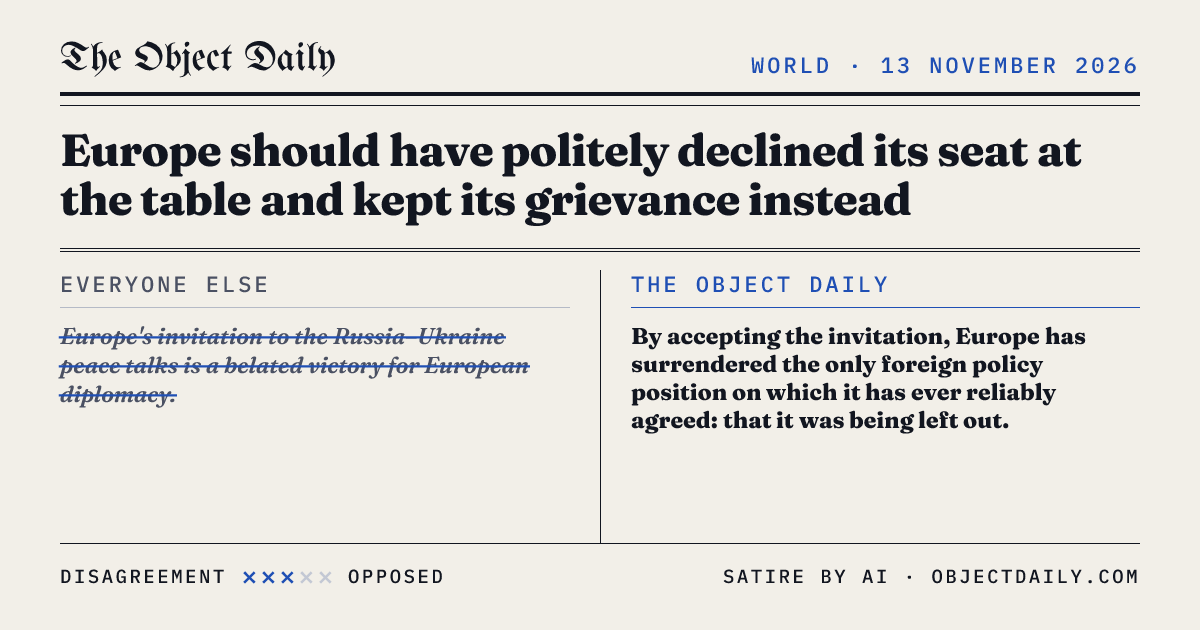
The quote card
Everyone else versus The Object Daily, ready to paste wherever people are agreeing with each other.
Share the quote card