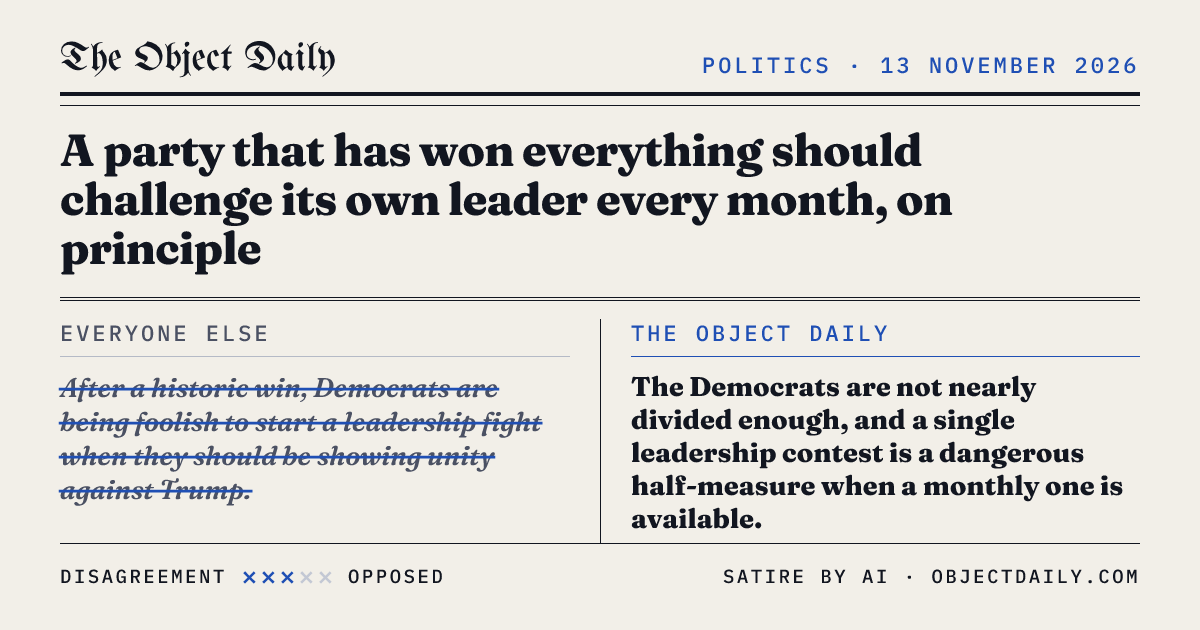
A party that has won everything should challenge its own leader every month, on principle
Commentators warn that Senate Democrats are being foolish to fight over the leadership after their midterm sweep. The real danger is that they will fight only once.
A message from the editorsVote against us ↓
- Everyone else
After a historic win, Democrats are being foolish to start a leadership fight when they should be showing unity against Trump.- The Object Daily
- The Democrats are not nearly divided enough, and a single leadership contest is a dangerous half-measure when a monthly one is available.
I disagree.
Not with Senator Van Hollen, who announced on Thursday that he will challenge Senator Schumer for majority leader. Nor with Senator Schumer, who says he has the votes. Nor even with Senator Sanders, who has picked a side. I disagree with everybody else, namely the commentators who have spent the week explaining that a party which has just swept the midterms is being foolish to start a leadership fight. The fight is not the problem. The problem is that there is only one of it.
Consider the mechanics of unity. A party out of power unites against the party in power. A party that has just won, however, finds that the voters have helpfully reduced its opponents to a manageable size. According to an estimate I made this morning, the supply of external enemies available to a newly victorious caucus falls by roughly 60 per cent on the morning after polling day. The coalition must then locate an enemy within reach, and the nearest one is always sitting in the same room, usually in the chair at the end.
A single contest is therefore worse than useless. It produces one burst of energy, one vote and one winner, after which the caucus is obliged to spend two years agreeing with itself. Morale spikes and decays like a sugar rush. By 2028 the party will have nothing left to feel strongly about except the catering.
What is required is a sustainable supply. I propose a Standing Leadership Contest, held monthly, in every chamber, committee and subcommittee, administered on three simple forms: LC-1 (Expression of Mild Dissatisfaction), LC-2 (Formal Challenge) and LC-3 (Notice of Reluctant Reconciliation, valid for 28 days and not renewable). The returning officer should be somebody with a livestream and a large audience, so that each count can be monetised to fund the next one.
I am aware of the objection: but what about Trump? I note that the same commentators demanding unity would be the first to complain about a party of identical opinions. A caucus that always agrees does not have a hundred ideas; it has one idea and a great many spare seats. Disagreement is not a distraction from politics. It is the only part of politics that requires no outside funding.
Westminster has long treated the leadership contest as a seasonal sport rather than a crisis, and the buildings are still standing. Americans, who invented the permanent campaign, have simply failed to point it at themselves.
There is a further benefit. Under a monthly rota, roughly half of all Democratic senators could expect to serve as leader at least once before 2028, with the rest guaranteed a turn soon after, which would eliminate ambition as a source of friction altogether. Nobody plots for a job they will be handed in March.
In the interests of consistency, I have this morning submitted Form LC-2 against the present column. Should it survive the count, I shall challenge it again next Friday.
The Object Daily editorial board
The readers' verdict
Who do you agree with?
agree with everyone else agree with The Object Daily
Index points
- Never12
- Once per Congress31
- Annually44
- Quarterly63
- Monthly88
- Weekly71
Monthly contests deliver peak morale; weekly ones exhaust the supply of forms.
Source: The Object Daily Unity Desk, estimate made this morning using Form LC-1 · Satire
Three further objections
The reasonable one
A leader facing a contest every month would spend all their time campaigning for the job rather than doing it, though it is not obvious anyone would notice the difference.
The bureaucratic one
Forms LC-1 to LC-3 have not been through the statutory consultation period, and any change to them would itself require a leadership contest to approve.
The absurd one
A monthly contest would clash with the Capitol's monthly fire alarm test, and nobody could be sure whether senators were leaving the room in protest or by procedure.
Satire. This article was written by AI from real news headlines. The opinions are invented and deliberately contrary. The Object Daily does not claim that any of this is true, wise or even reasonable. Our editorial standards.
- us politics
- congress
- elections
The quote card
Everyone else versus The Object Daily, ready to paste wherever people are agreeing with each other.
Share the quote card