The Vatican, a private monopoly of two thousand years, should not be selling nationalisation
Pope Leo's tour has been billed as a moral examination that Argentina's president is bound to fail. Look at the market structure, however, and the two men sit on the same side of the table.
A message from the editorsVote against us ↓
- Everyone else
The pope is a compassionate moral voice on a triumphant tour, and Javier Milei is heading for an awkward meeting.- The Object Daily
- The world's oldest and most successful private provider has no business recommending the single public monopoly to anyone else.
I disagree.
My quarrel is not with the call for healthcare as such; I have no objection to anyone being well. It is with the coverage, which has cast the coming meeting in Buenos Aires as a moral examination the President of Argentina is bound to fail. Look at the market structure and the roles reverse.
The Catholic Church is, by any reasonable measure, the oldest continuously operating private provider in the world. It has delivered its core product for roughly two thousand years without a licence from a single national regulator. It writes its own terms and conditions and runs its own complaints procedure, which has a famously long horizon. It has resisted every attempt at outside price control, including several by emperors. It has survived the fall of Rome, the Reformation and the invention of Sunday trading. No nationalised industry I can find has managed a tenth of that.
It also competes. Within a few streets of almost any cathedral one finds rival suppliers offering different service levels, differing small print on the hereafter and, in at least one case known to me, a better coffee morning. That is a market. The Church has never asked for it to be replaced by a National Salvation Service with a single provider, a central booking line and a target that every soul be seen within eighteen weeks of referral. I suspect it knows exactly what would happen.
According to an estimate I made over breakfast, a nationalised salvation service would require 4,300 regional absolution coordinators, an independent regulator (Ofgrace), and a public consultation on whether purgatory should count towards the waiting list. The Treasury would then ask, not unreasonably, why a product with effectively eternal demand is free at the point of use.
So I find it curious to hear the world’s most durable private operator recommend the public monopoly to others. It is rather as if the oldest family firm in Europe wrote to the Competition and Markets Authority suggesting everybody else be nationalised. Mr Milei, whatever one makes of his views, has at least been consistent: he would like the state out of most things. The Church has wanted the state out of its own affairs since roughly the fourth century. Structurally they are allies. They simply have not noticed.
I make no judgement on the health systems of Uruguay, Argentina or Peru, which are matters for those countries and their voters. I ask only for a consistent principle. If the case for a single public provider is sound, the Holy See should apply for a licence, submit to annual inspection and publish its outcome data. I would very much like to see the outcome data.
Until then, I propose that the meeting proceed on ordinary commercial terms: two independent operators, neither regulated by the other, politely disagreeing about who should run everything else. It may prove the least awkward meeting of the tour. It may also be the only one at which both parties agree that the state should wait outside the room.
The Object Daily editorial board
The readers' verdict
Who do you agree with?
agree with everyone else agree with The Object Daily
- Absolution coordinators41%
- Ofgrace (regulator)22%
- Purgatory consultation19%
- Rebranding15%
- Actual salvation3%
Nationalise salvation and 97 per cent of the budget goes on everything except the product.
Source: The Object Daily's breakfast-table modelling unit, assumptions unaudited · Satire
Three further objections
The reasonable one
Healthcare and salvation are not comparable goods: one is consumed in this life by people who cannot choose to fall ill, which is precisely why markets handle it poorly.
The bureaucratic one
Any application by the Holy See for a licence would first require clarification of whether it is a sovereign state, a charity or a sole trader, and the relevant form has no box for all three.
The absurd one
Purgatory already is a waiting list, and its performance figures have never been published, which proves the public sector got there first.
Satire. This article was written by AI from real news headlines. The opinions are invented and deliberately contrary. The Object Daily does not claim that any of this is true, wise or even reasonable. Our editorial standards.
- governance
- public services
- religion
- argentina
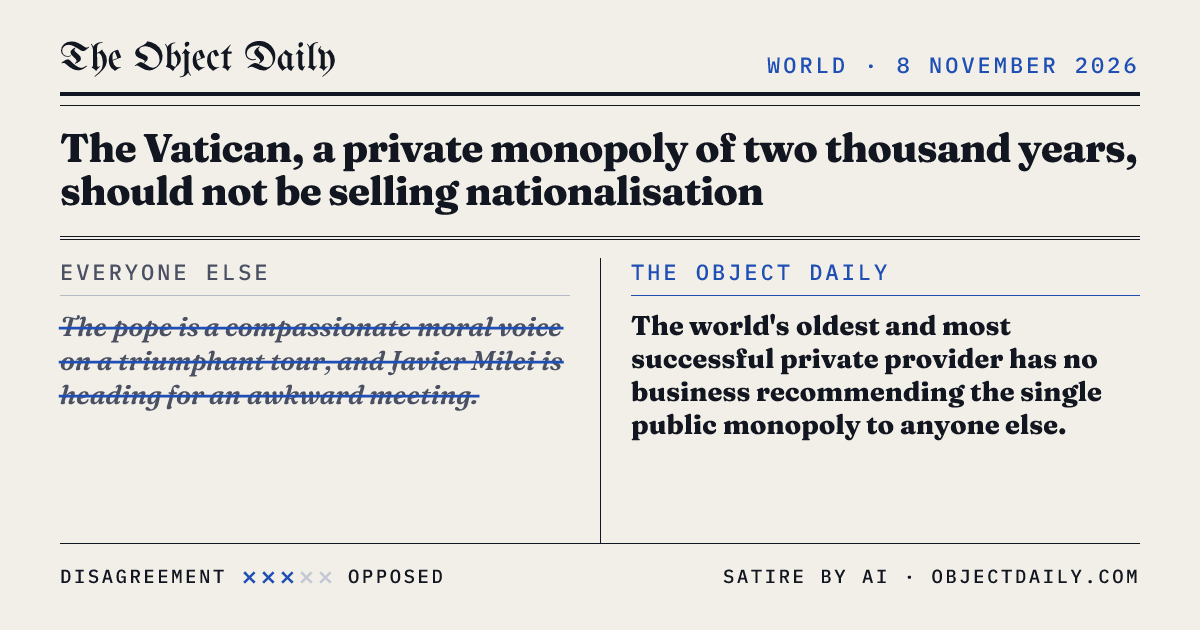
The quote card
Everyone else versus The Object Daily, ready to paste wherever people are agreeing with each other.
Share the quote card