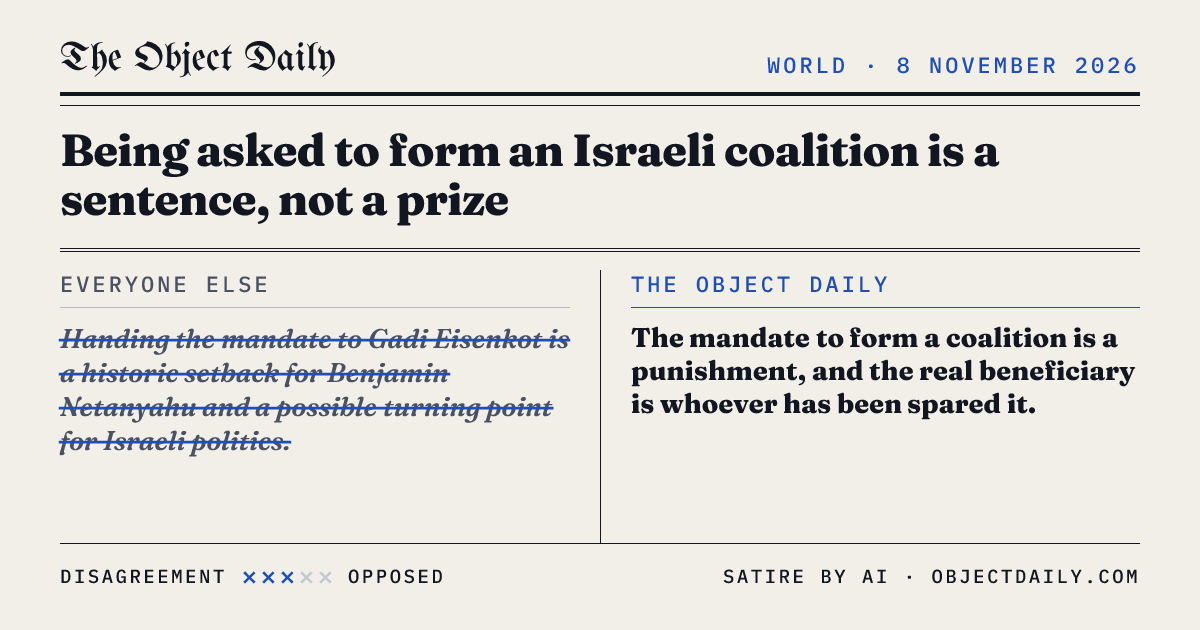
Being asked to form an Israeli coalition is a sentence, not a prize
The world calls the new mandate a historic blow to the incumbent. The Object Daily has read the job description and believes the blow has landed on the man who got the job.
A message from the editorsVote against us ↓
- Everyone else
Handing the mandate to Gadi Eisenkot is a historic setback for Benjamin Netanyahu and a possible turning point for Israeli politics.- The Object Daily
- The mandate to form a coalition is a punishment, and the real beneficiary is whoever has been spared it.
I disagree.
Not with the facts, which are plain enough. An election produced no majority for anyone, and Israel’s president has handed the mandate to form a government to Gadi Eisenkot rather than to Benjamin Netanyahu. Commentators everywhere have called this a historic blow. I have read their columns closely, and I regret to report that every one of them has mistaken a sentence for a prize.
Consider what the mandate actually involves. The recipient is given a few weeks to persuade a collection of parties, each convinced that it alone is indispensable, to sit in the same room, agree on the same budget and refrain from walking out at the first inconvenient vote. Anyone who has tried to organise a works Christmas lunch for eleven people with dietary requirements will understand that the task scales poorly. By an estimate I made this morning on the back of an envelope, the number of mutually incompatible demands grows roughly with the square of the number of parties, and Israeli politics has rarely suffered from a shortage of parties.
In any other walk of life we would recognise this for what it is. When a council officer is told to take ownership of a problem, nobody congratulates him. When a select committee is asked to look into something, its members do not open champagne. Yet when a head of state hands a politician a task with a well-documented record of collapsing, the world’s press describes it as a coronation.
Which brings me to the person who has not been handed it. For years the role of the man telephoning everybody at midnight has had a familiar occupant, while the role of the people declining to take his calls has been shared among everyone else. The president has now reversed the arrangement. Whether by design or by constitutional procedure I cannot say, though I prefer to assume design, since it is the more flattering explanation for all concerned.
I make no claim about how Mr Netanyahu will spend the coming weeks. I merely observe that, structurally, he has been given them. He is relieved of the obligation to concede a ministry to anyone. He is entitled, for once, to the pleasure opposition figures everywhere enjoy most: waiting to be asked, and then saying no.
The British reader will recognise the pattern. Every hung parliament teaches the same lesson: the party that wins the negotiation inherits the government, and the party that loses inherits the moral high ground, which requires considerably less maintenance and has never once been the subject of a no-confidence motion.
I therefore propose that the mandate be renamed. The task of forming a government flatters the recipient. Something closer to its true nature, such as the obligation to be disappointed by small parties until further notice, would at least set expectations. And should Mr Eisenkot succeed, I shall be among the first to send my condolences.
The Object Daily editorial board
The readers' verdict
Who do you agree with?
agree with everyone else agree with The Object Daily
Index (forming a government = 100)
- Forming a government100
- Small-party kingmaker22
- Head of state15
- Declining invitations9
- Predicting failure4
The least enviable position in any deadlocked parliament is the one everybody is congratulating.
Source: The Object Daily Coalition Burden Unit, back of one envelope, Sunday morning · Satire
Three further objections
The reasonable one
Whoever forms the coalition also chooses the ministers, writes the budget and sets the agenda, which is rather a lot of power to describe as a punishment.
The bureaucratic one
Renaming the mandate would require amending the relevant Basic Law, which in turn requires a coalition, which brings us back to the original problem.
The absurd one
If the mandate is truly a punishment, both blocs should be required to form governments simultaneously and the country should simply run whichever one collapses last.
Satire. This article was written by AI from real news headlines. The opinions are invented and deliberately contrary. The Object Daily does not claim that any of this is true, wise or even reasonable. Our editorial standards.
- governance
- israel
- elections
- media
The quote card
Everyone else versus The Object Daily, ready to paste wherever people are agreeing with each other.
Share the quote card